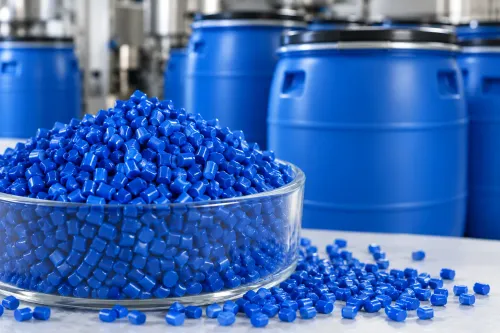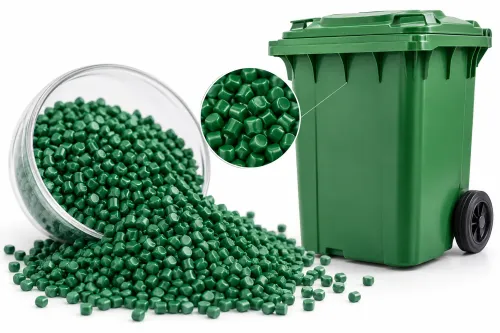
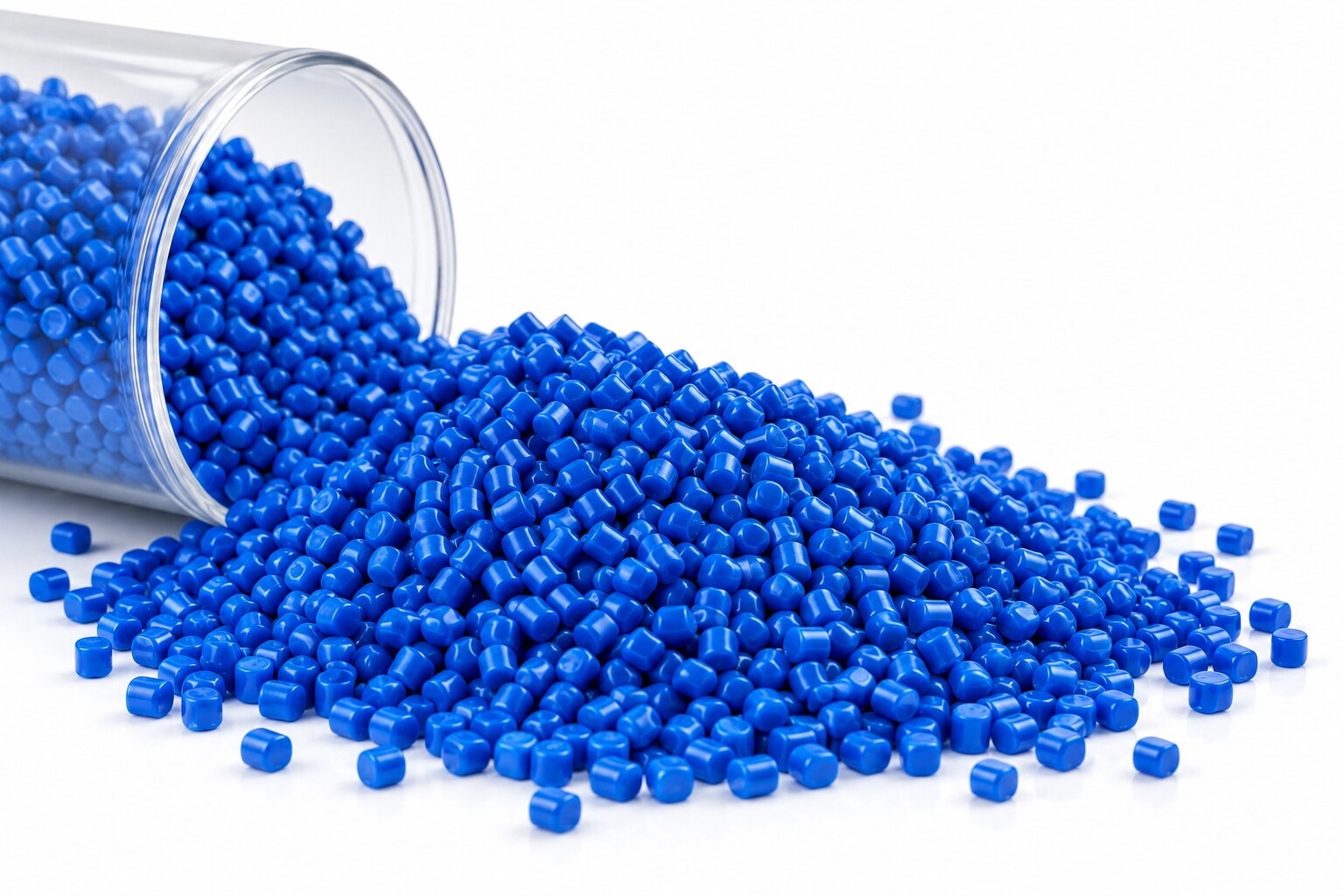
A masterbatch that produces an attractive colour in a cap or laboratory plaque can still create haze, streaks, poor stretchability or food-contact risk in a bottle. By the end, you will be able to match the concentrate to the bottle process and resin, calculate a workable dose, define measurable colour limits, and approve production trials with evidence rather than a shade name.
Key takeaways
- Match the carrier resin to PET, HDPE, PP or recycled PET before ordering.
- Request food-contact documents, additive details, batch data and recommended dosage.
- Define colour with measured targets for shade, opacity, gloss and transparency.
- Test dispersion, bottle performance and recycling effects at production conditions.
Match the masterbatch to the bottle process and polymer
Before comparing colours or prices, identify the polymer, process, melt temperature, residence time and drying conditions. Document PET carrier resin compatibility for PET, with separately validated systems for HDPE, PP and recycled PET.
| Process and resin | What to verify | Why it matters |
|---|---|---|
| PET stretch blow moulding | PET carrier, preform dispersion, stretchability and thermal stability | An incompatible generic polyolefin carrier can cause gels, haze, poor preform stretchability and local defects after stretching. |
| Injection moulding | Use a PET concentrate for PET preforms; validate PP or HDPE concentrates separately for caps | Preform IV retention and appearance differ from cap torque, seal and stress-cracking requirements. |
| Extrusion blow moulding | Match the carrier to HDPE or the specified container polymer; check melt strength and die dispersion | A formulation suited to PET preforms or injection moulding can produce streaks, weak parisons or uneven container walls. |
PET is moisture-sensitive. Specify the masterbatch moisture limit and conditioning instructions, dry resin and concentrate as required, then measure intrinsic viscosity before and after processing; hydrolysis can lower IV and weaken bottles even when colour looks correct.
Compare pigment stability at PET melt temperature and actual residence time: a pigment acceptable in PE film can drift, decompose, create specks or reduce transparency in PET. For each incoming rPET lot, record yellowness, haze, IV and contaminant history before approving a formulation. Bottle-body concentrate cannot automatically transfer to caps, closures, labels or handles.
Set compliance, additive and dosage requirements before ordering
Request a compliance file that covers the complete bottle, not pigment alone: food-contact declaration, composition statement naming pigments, carrier and additives, migration-test report, processing conditions, concentration limits, and a statement covering the finished article.
1. For India, request evidence against the applicable FSSAI requirements for drinking-water packaging. For the EU, request assessment under EU Regulation (EU) No 10/2011, including overall migration limits of 10 mg/dm² or 60 mg/kg food under specified conditions. For the United States, check the relevant FDA provisions, including 21 CFR 177.1630 for polyethylene phthalate polymers.
2. Set the target let-down ratio for every shade and additive before ordering. Calculate each batch as: masterbatch kilograms = resin batch kilograms × dosage percentage ÷ 100. Require feeder calibration and a weighing check; use gravimetric feeding when low doses make volumetric errors visible.
3. Treat UV absorbers, optical brighteners, oxygen scavengers and acetaldehyde scavengers as separate decisions tied to specific failure modes. Check their effect on transparency, migration, fluorescence, recycling and release testing instead of accepting an undefined performance package.
4. Do not treat an acetaldehyde scavenger as a substitute for PET drying or process control. Excess moisture, melt temperature, residence time and shear can increase acetaldehyde, so validate PET drying and use headspace-GC testing on preforms or bottles when taste risk matters.
Choose the colour system and define appearance with measurements
Choose masterbatch when you need clean handling, repeatable dosing and quick colour changes between bottle runs. Compare the alternatives against your production volume and changeover discipline, not only the quoted colour price.
| Option | Main advantage | Main risk or cost |
|---|---|---|
| Masterbatch | Clean handling, repeatable dosing and easier colour changes | Requires feeder calibration and a compatible carrier |
| Pre-coloured resin | Strong batch-to-batch consistency | Higher material cost and more inventory for each shade |
| Liquid colour | Precise metering at low addition rates | Needs dosing equipment, clean lines and proven dispersion |
| Dry pigment | Low apparent colour cost | Creates dust and weighing work, with greater agglomeration risk |
For clear or translucent bottles, set limits for haze, transparency, sparkle and yellowness index before approving a shade. For opaque bottles, add whiteness, tint strength and gloss.
Provide a physical colour standard, then measure samples with a spectrophotometer using D65 illumination and a defined 2° or 10° observer; specify a numerical ΔE tolerance, gloss angle and haze limit instead of “blue” or “white”.
Approve the formulation on the actual preform and blown bottle. Stretch orientation, wall thickness, crystallinity, bottle geometry and optical path length can change lightness and hue after moulding. For a clear water bottle, reject a formulation that meets average ΔE but shows visible haze or sparkle.
Capture the limit in the approval record, such as ΔE00 ≤ 1.0, gloss at 60°, and haze below the agreed percentage.
Test dispersion, bottle performance and recycling impact
A plaque can hide a concentrate that fails after stretching. Run the actual injection and stretch-blow trial, then judge both the preform and bottle.
| Test | Method | Acceptance evidence |
|---|---|---|
| Pigment dispersion | Preform inspection and blown-bottle inspection under controlled lighting | No specks, streaks, gels, fisheyes or agglomerates at the agreed inspection distance |
| Colour and optics | Measure haze and ΔE on preforms and bottles; inspect stretched walls | Limits met, with no colour bands or wall-thickness-related shade changes |
| Process and structure | Record preform weight distribution, stretch-blow window, volume and crystallisation behaviour | No unexplained lot-to-lot drift or narrowed processing window |
| Bottle performance | Test top-load, paneling, drop performance and closure fit | Results meet the bottle specification |
| Recycling | For black packaging, verify a non-carbon-black, NIR-detectable black against the target recycler’s sorting specification | Correct detection and sorting confirmed |
Set the limits before production starts. A PET-compatible carrier does not guarantee unchanged crystallisation or stretch behaviour; a colour match that narrows the blow-moulding window is not an equivalent replacement.
Keep cap and closure trials separate. Their carrier, melt temperature, stress-cracking resistance, torque and seal requirements differ from the bottle body.
Record these fields in the approval report:
- Resin lot, dosage, drying conditions and melt temperature
- Residence time, feeder settings and test results
- Inspection distance, lighting conditions, haze, ΔE and lot numbers
Approve the concentrate only after results remain consistent across representative resin lots.
Turn the specification into a supplier approval decision
A product name or colour chip cannot approve a concentrate. Supplier qualification starts with a technical data request, followed by a trial on your bottle resin, equipment and target wall thickness. Ask Khetan Polytex Private Limited, or any candidate supplier, to provide measured evidence rather than a catalogue description.
- Request carrier polymer, pigment and additive composition, recommended dosage range, moisture limit, thermal-stability data, storage and conditioning instructions.
- Require food-contact documents for the target market: a complete masterbatch declaration, composition statement, migration-test report, test conditions, concentration limits and finished-article coverage. Check EU Regulation (EU) No 10/2011, India FSSAI requirements or relevant FDA provisions, including 21 CFR 177.1630.
- Specify certificate of analysis fields: batch number, production date, carrier, colour values, dosage, moisture, and release results. Require batch traceability from raw material to shipment.
- Run the trial at target dosage and compare colour, haze, dispersion, IV before and after processing, acetaldehyde where relevant, bottle performance and feeder repeatability.
- Approve virgin PET and rPET separately when incoming colour, haze, IV or contamination history varies by source. Record separate control samples and reapproval triggers for pigment, carrier or additive changes.
| Approval factor | Virgin PET | rPET |
|---|---|---|
| Baseline | Controlled resin lot | Source-specific colour, haze and IV |
| Acceptance | Fixed colour and process limits | Limits confirmed for each source |
| Review | First-production bottles retained | Every changed source or contamination profile reviewed |
Review bottles after transport and storage. Compare total material cost, including rejected preforms, slower colour changes and a narrower blow-moulding window—not merely concentrate price.
Related products
 | masterbatches High-Quality Black Masterbatch Manufacturers and Supplies in India. Khetan Polytex is one of the leading black masterbatch manufacturers in India. View product → |
 | Desiccant Masterbatch ₹55 Desiccant Masterbatches can counter problems that develop during the processing of plastics due to the presence of moisture and prevents the... View product → |
Frequently asked questions
How do you match a masterbatch to a water bottle process and polymer?
Identify the bottle polymer, forming process, melt temperature, residence time and drying conditions. Use a PET-compatible carrier for PET bottles and separately validate systems for HDPE, PP and recycled PET.
What information should you set before ordering a bottle masterbatch?
Specify food-contact compliance, restricted substances, additive identity, target dosage, carrier resin, batch documentation and processing conditions. Confirm that the supplier can provide the required licence or compliance records for your market.
How should you define the colour of a plastic water bottle?
Set an approved colour standard and measure shade, opacity or transparency, gloss and visual uniformity. Record instrument results and viewing conditions instead of approving colour from a verbal description alone.
What tests should you run before approving a masterbatch supplier?
Check pellet dispersion, bottle appearance, top-load or impact performance, seal and shrink behaviour where relevant, and effects on recycling. Run trials at production temperature, dosage and residence time before approval.
Related products
 | BLUE MASTERBATCH ₹300 Enhance your Plastic Products with Superior Blue Masterbatch! Blue Masterbatch is a high-quality colouring solution designed to provide plastic with... View product → |
 | masterbatches ₹200 Khetan Polytex is a leading white masterbatch manufacturers that offer products with wide applications in the plastic industry. View product → |
 | FILLER MASTERBATCH Most Reliable Filler Masterbatch Manufacturers in Jaipur, India We have been continuously innovating their product lines to keep up with the demands... View product → |
 | VIOLET MASTERBATCH ₹325 VIOLET 13007 MASTERBATCH IS A BRIGHT VIOLET COLOR WITH HIGH COLOR STRENGTH. View product → |