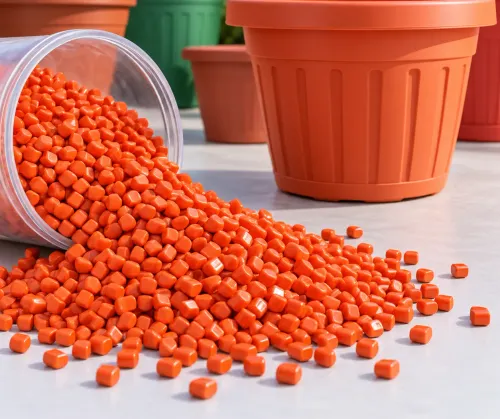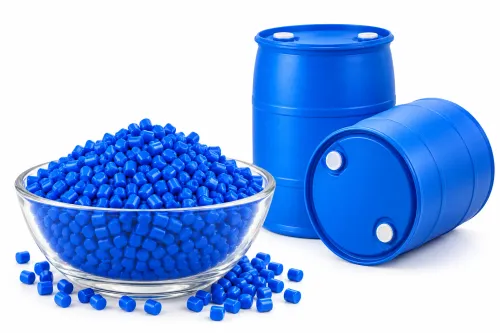
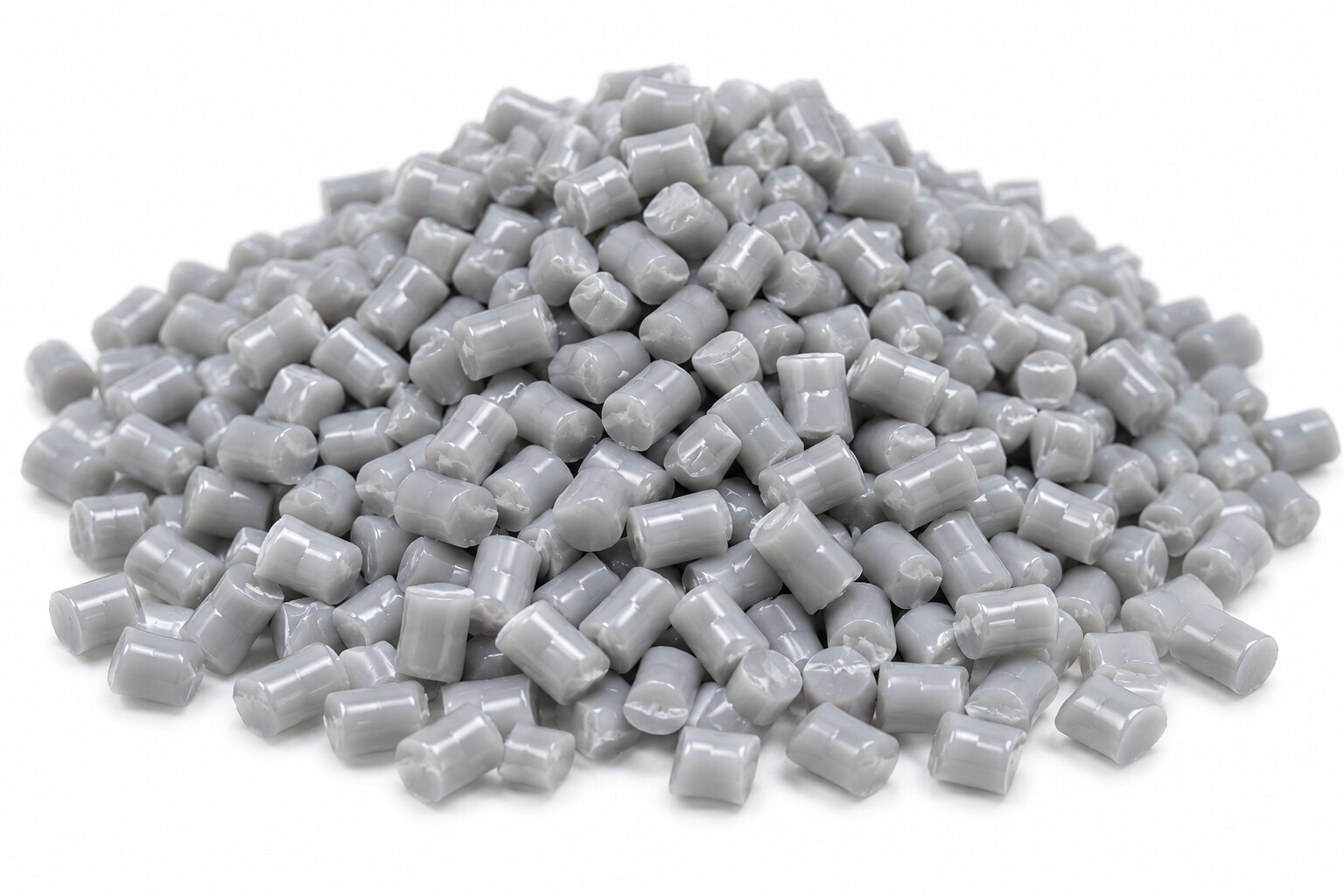
A PP-pipe masterbatch must match more than the colour shown in a catalogue: dosage, pigment strength, carrier chemistry, mixing history and thermal exposure all affect the finished pipe. By the end, you will have a method for selecting candidates, running a controlled trial and rejecting grades that create unstable colour, defects or process risk.
Key takeaways
- Define shade, opacity, gloss and marking contrast before selecting colourant.
- Trial the masterbatch at the intended let-down ratio and extrusion conditions.
- Use pipe specimens to identify streaks, specks, gels and poor dispersion.
- Compare suppliers using compatibility data, compliance documents and production cost.
Define the finished-pipe appearance before choosing the colourant
Start with the pipe’s approved visual target, not the masterbatch catalogue. Record the base PP colour, target shade, surface finish, marking contrast, opacity and gloss in pipes, then make the comparison on specimens produced at the intended let-down and extrusion conditions.
A plaque that passes shade matching under high laboratory shear can streak in a pipe line with weaker distributive mixing.
| Application | Appearance decision | Colourant implications |
|---|---|---|
| Full-wall pipe | Uniform shade through the wall, required opacity and surface gloss | Select pigment strength and carrier for the complete PP formulation; verify dispersion at the pipe line’s shear and residence time |
| Stripe or identification line | Sharp contrast, clean edges and consistent width | Use a concentrated masterbatch suited to the stripe layer, not automatically the dosage used for full-wall colouring |
| Surface layer | Even skin colour without die lines, specks or gloss variation | Confirm compatibility with the layer resin, die temperature and adjacent PP; check that pigment does not migrate or build deposits |
For outdoor pipe, colour does not prove UV protection. Evaluate black masterbatch carbon-black loading, dispersion and weathering in the intended PP; non-black shades may need a separate UV stabilizer package. Rutile titanium dioxide suits demanding white applications, but surface treatment and dispersion affect filter pressure, die lines and chalking.
Treat pigment-strength data as a colour guide, not a weathering result.
For potable-water or regulated pipe, assess pigments, carrier, stabilizers and processing aids in the final PP formulation. A general compatibility or food-contact statement does not establish compliance with the applicable pipe standard, positive list or migration limit.
Set the let-down ratio and run a controlled dosage trial
A 50% pigment masterbatch at a 2% let-down contributes 1% pigment to the PP compound. Calculate it as: final active pigment concentration = masterbatch let-down ratio × active pigment concentration. A 40% product therefore needs a 2.5% dose to deliver the same 1% pigment; using it at 2% changes both shade strength and carrier content.
For light, medium and dark shades, begin trials at 0.5–1%, 1–2% and 2–4% respectively. Treat these as starting points: pigment strength, opacity and pipe-wall thickness determine the final dose.
Run the dosage trial in this order:
- Weigh the PP resin and masterbatch separately, then record the masterbatch percentage against total compound weight.
- Use the intended screw speed, melt temperature, output and cooling settings.
- Purge the extruder until the previous colour is gone, then collect pipe samples after the new colour stabilises.
- Compare each sample with the approved shade plaque made at the same let-down and processing conditions.
Increase or reduce dosage in small, recorded steps; large jumps create shade drift and hide the true optimum. The lowest-dose masterbatch is not automatically cheapest. A concentrated grade reduces carrier and hopper consumption but can be difficult to meter accurately at very low levels, while a less concentrated grade can improve dosing resolution and dispersion.
Compare cost per unit of final pigment or additive, required dosing accuracy, purge losses and reject rate before approving the dose.
Check dispersion in the extruded pipe and diagnose the defect
A defect is more likely to come from poor pigment dispersion when it follows the masterbatch rather than a stable extruder condition. Agglomerates create streaks and specks, raise screen-pack pressure, form die deposits and leave colour clouds through the pipe wall.
1. Purge the line, stabilise melt temperature, screw speed, haul-off and feed rate, then collect pipe from the same production interval. Mark the machine settings, screen-pack pressure and defect location.
2. Cut the pipe across its wall and along its length. Look for pigment clusters, coloured trails or uneven shade beneath the surface; confirm them with a low-power microscope or polished cross-section. A surface colour check alone can miss poor pigment dispersion.
3. Repeat the run with the same PP and settings but without the masterbatch, then with a fresh batch or another approved grade. If the streaks, specks or colour clouds disappear, or move with the masterbatch lot and dosage, suspect dispersion, pellet integrity or feeding accuracy.
4. Treat die lines and die deposits as process-related when they remain with uncoloured PP, begin at one die land, change after cleaning, or track a temperature, pressure or residence-time change. A defect that worsens with screen restriction points to retained agglomerates or contamination.
Approve the colourant only after specimens made at the intended let-down and pipe-line conditions pass both the appearance check and the cut-section examination. A high-shear plaque can hide a problem that appears in a lower-mixing pipe extruder.
Validate PP compatibility, temperature tolerance and line conditions
Confirm the exact PP pipe compound before approving a colourant: homopolymer, random copolymer, impact-modified grade, filler content, stabiliser package and target melt-flow rate. PP carrier compatibility means the carrier melts into the resin without forming a separate phase or weakening weld lines.
A carrier suitable for general-purpose PP can still alter viscosity or crystallisation in a high-crystallinity or impact-modified compound.
Ask for the following production data:
- MFR values for both materials, including test temperature and load. ISO 1133 results at 230°C and 2.16 kg are not directly comparable with results taken at another load.
- The line’s actual peak melt temperature, not only barrel setpoints. Request heat-stability data at that temperature.
- Screw design, output rate, screen-pack arrangement, die type and whether the line provides distributive mixing.
- Minimum and maximum residence time, including the material volume held in the barrel during a stoppage, restart or purge.
- Evidence of shear sensitivity, including colour or viscosity change after the intended processing history.
| Check | Confirm | Failure if missed |
|---|---|---|
| Carrier and PP | Same melt phase at processing temperature | Weak weld lines, gels or unstable pressure |
| Melt-flow behaviour | Comparable data under identical test conditions | Poor feeding or colour variation |
| Temperature and time | Peak melt temperature plus residence-time assessment | Fading, gas, plate-out or die deposits |
| Line mixing | Screw shear, screen pack and output rate | A plaque passes while pipe shows streaks |
For potable-water pipe, assess the complete final formulation against the applicable pipe standard and positive-list or migration requirements; a general food-contact statement is not enough.
Compare suppliers using production evidence, compliance and total cost
Do not approve a supplier from a colour card alone. Require an approved shade plaque made at the intended let-down, PP grade, extrusion temperature and cooling conditions, then record the sample geometry, instrument geometry and CIELAB Delta E tolerance.
A flat plaque can match while curved pipe fails because gloss, wall thickness and measurement angle change the reading.
| Supplier evidence | What to require | Why it decides approval |
|---|---|---|
| Technical file | TDS, SDS, pigment or additive identification, carrier resin, recommended let-down, MFR test method, batch CoA and traceability | Confirms repeatability and prevents comparison of MFR values measured at different loads or temperatures |
| Production trial | Pipe samples from the intended line, after colour stabilises, with records of screw, temperature, residence time, screen pack and dosage | Exposes streaks, specks, die deposits and feeding errors hidden by a high-shear plaque test |
| Performance file | Opacity, gloss, marking contrast and weathering performance; for black, carbon-black loading and dispersion | Shows whether the colour survives outdoor exposure and delivers the required identification mark |
| Regulatory file | A declaration covering the complete PP formulation, including carrier, pigments, stabilizers and processing aids, plus migration or positive-list evidence | A food-contact statement alone does not prove potable-water compliance |
Use a commercial comparison that includes cost per final pigment or additive, metering accuracy, purge losses, rejected pipe and the carrier added at the actual dosage. The lowest-dose product can cost more if it is difficult to feed consistently.
Ask Khetan Polytex Private Limited for the same production records and formulation-specific compliance evidence you require from every shortlisted supplier.
Related products
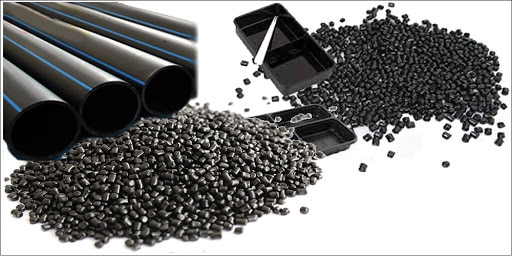 | masterbatches High-Quality Black Masterbatch Manufacturers and Supplies in India. Khetan Polytex is one of the leading black masterbatch manufacturers in India. View product → |
 | GREY MASTERBTACH ₹160 GREY 12006 IS A LIGHT GREY MASTERBATCH. IT IS CLEAR,SHINE GREY TONING MASTER BATCH WITH EXCELLENT DISPERSION AND ESILY COMPATIBLE WITH PE PE RESIN.IT... View product → |
Frequently asked questions
What should you define before choosing a masterbatch for PP pipes?
Record the base PP colour, target shade, surface finish, marking contrast, opacity and gloss using an approved pipe specimen.
How do you set the masterbatch dosage for PP pipe?
Set a proposed let-down ratio, then run a controlled trial at the intended extrusion conditions and compare the pipe with the approved visual target.
How can you diagnose poor masterbatch dispersion in an extruded PP pipe?
Inspect the pipe for streaks, specks, colour variation, gels and unmelted particles, then relate each defect to mixing, dosage, temperature or contamination.
What should you validate before using a masterbatch in PP pipe production?
Confirm PP compatibility, temperature tolerance, pigment stability and performance on the actual extruder, screw, throughput and cooling conditions.
How should you compare masterbatch suppliers?
Review production trial results, technical and compliance documents, batch consistency, recommended dosage, supply reliability and the total cost per finished pipe.
Related products
 | masterbatches ₹200 Khetan Polytex is a leading white masterbatch manufacturers that offer products with wide applications in the plastic industry. View product → |
 | Khetan Polytex are leading colour master batches manufacturers in India, Jaipur. Colour Masterbatches are used for coloring plastics and their dyes. View product → |
 | GREY MASTERBTACH ₹168 DARK GREY E- 12034 HAS DARK GREY COLOR SHADE. IT HAS EXCELLENT HEAT STABILITY AND COMPATIBILITY WITH PE PP RESIN.IT HAS WIDELY USED IN MOULDING... View product → |
 | BLUE MASTERBATCH ₹220 BLUE MASTERBATCH WITH BRIGHT TONE OF BLUE COLOR ,EASILY COMPATIBLE WITH PE AND PP RESINS,STABLE WITH CHANGES IN WEATHER AND SURROUNDINGS .ABILITY TO... View product → |