A pipe can leave the extruder with the right colour and still fail because the carrier, dosage, dispersion or weathering package is wrong for its resin and service environment. By the end, you will be able to specify a suitable concentrate, calculate its feed rate, check colour along a coil and demand evidence that supports the intended outdoor use.
Key takeaways
- Match the carrier to the pipe resin before selecting pigment.
- Set and record the let-down ratio before production extrusion.
- Inspect colour across the full pipe coil, not one cut section.
- Test durability at the actual sunlight, moisture and heat exposure.
Choose the Carrier and Pigment Package for the Pipe Resin
Match the masterbatch carrier to the pipe’s base polymer before comparing colour. A carrier formulated for PE resin normally disperses reliably in HDPE, LDPE and compatible PE blends; a low-viscosity film-grade carrier can behave differently in an HDPE irrigation pipe, causing streaks, surface defects, altered melt strength or poor fusion.
| Resin or application | Carrier and package choice | Main risk to check |
|---|---|---|
| PE blend | Carrier matching the dominant PE component and melt-processing range | Phase separation or uneven dispersion |
| HDPE irrigation pipe | PE carrier with carbon black or colour pigment selected for pipe processing | High viscosity, streaks or weak points |
| LDPE tubing | Lower-viscosity PE-compatible carrier matched to the tubing melt flow | Poor mixing, die lines or unstable output |
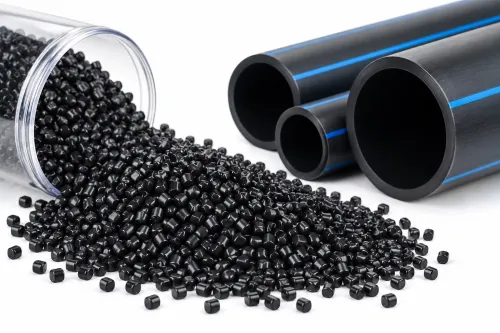
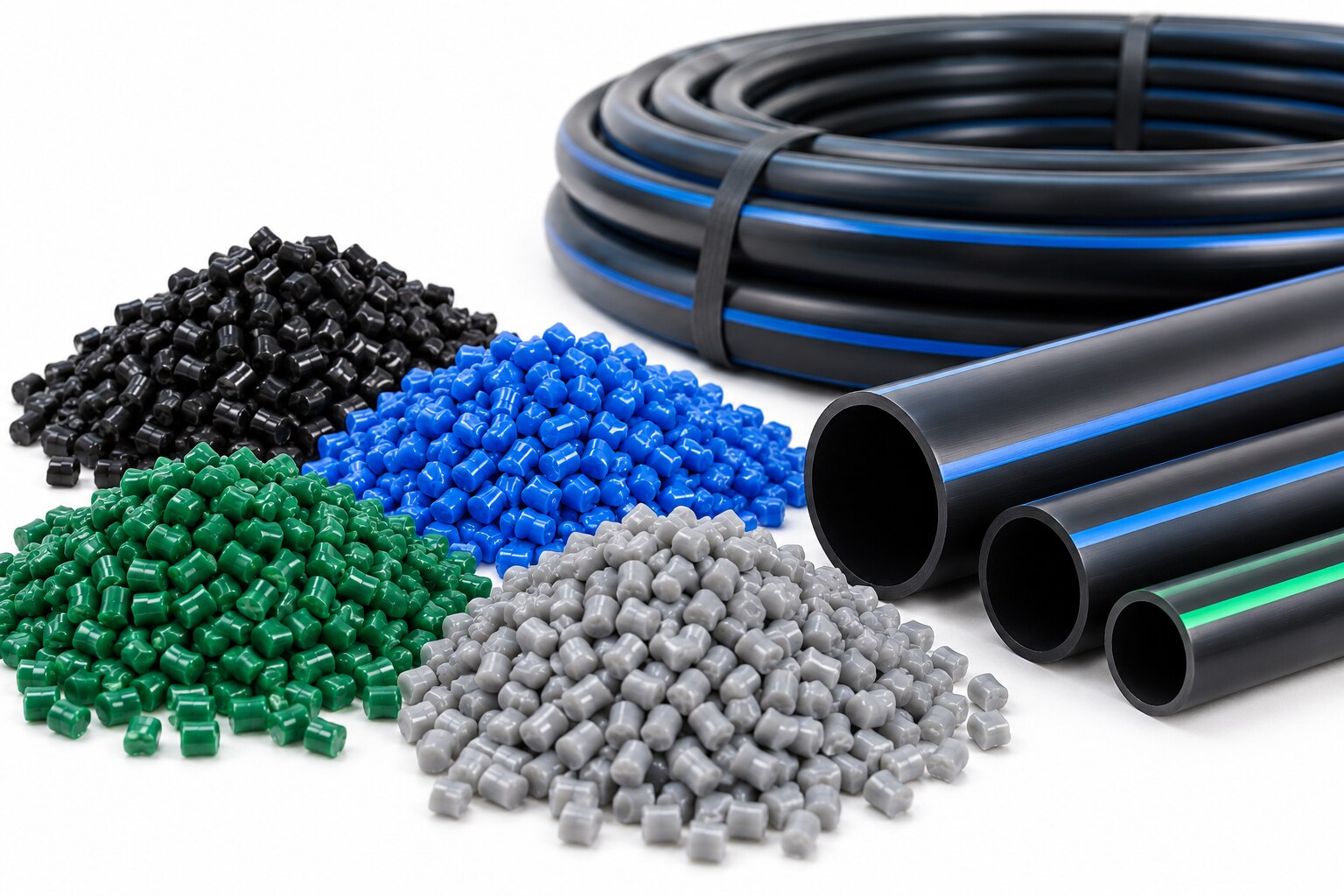
| Black outdoor pipe | PE carrier with qualified carbon black, UV package and dispersion | UV protection fails between agglomerates |
Treat carrier compatibility as a formulation decision, not a purchasing detail. Ask for the carrier polymer, pigment loading, recommended let-down ratio and processing-temperature range. Do not replace a qualified colour concentrate with a filler masterbatch; mineral filler changes stiffness, density and melt behaviour.
For black pipe, carbon black is part of the UV system, not merely a colourant. ISO 4427 and EN 12201 commonly target about 2.25% carbon black with ±0.25 percentage points, plus specified dispersion. For white or coloured pipe, check rutile titanium dioxide, HALS and UV absorber levels as a package rather than judging shade alone.
Verify dispersion in the finished pipe or compound using ISO 18553 or ASTM D5596. Recheck hydrostatic strength, oxidation-induction behaviour, melt flow and pigment dispersion after changing the carrier or let-down ratio.
Set the Let-Down Ratio and Control the Extrusion Feed
A 2% trial dosage gives a 1:49 let-down ratio: one part masterbatch to 49 parts pipe resin. For a 100 kilograms per hour final output, use this masterbatch dosage calculation: 100 × 0.02 ÷ 0.98 = 2.04 kilograms per hour, with resin at 97.96 kilograms per hour.
Use the qualified dosage, not a visual adjustment; excess concentrate raises cost and can alter shade, melt behaviour or additive concentration.
1. Confirm the target as a percentage of the final blend, then record the let-down ratio, masterbatch batch number and resin batch number. Recalculate kilograms per hour whenever line speed or total output changes.
2. Calibrate the gravimetric feeder with the actual pellets. Check discharge over a timed interval, inspect bridging in the hopper loading zone, and verify the resin-to-masterbatch ratio after refilling. Volumetric dosing needs tighter checks because changing pellet bulk density can produce a longitudinal shade stripe.
3. Keep the melt temperature within the carrier and pipe-resin processing window. Too little screw mixing leaves streaks; excessive heat or residence time can degrade colour or additives. Record screw speed, melt temperature and line speed with the dosage.
4. Sample pipe after the process reaches steady output, not during start-up. Purge the feeder and extruder with the approved resin or cleaning compound before changing colour, dosage or carrier, then confirm the next pipe section is free of the previous shade.
Define Colour Acceptance and Inspect the Entire Pipe Coil
Approve a colour only against pipe made on the intended extrusion line, not against a masterbatch pellet or laboratory plaque. Define the target with a RAL reference, a physical colour standard, the illuminant, observer, measurement geometry, surface gloss and sample thickness.
ASTM D2244 then provides the colour difference calculation, but you must state the permitted Delta E tolerance.
Use pipe coil sampling to prove stability through the run:
- Cut samples from the beginning, middle and end of each coil, and record the pipe batch, masterbatch batch, dosage, line speed and die temperature.
- Measure each sample with the same colourimeter, aperture, geometry and light source. Compare the readings with the physical colour standard, then inspect for longitudinal streaks, die lines and visible shade shifts.
- Repeat the check on both a thin-wall section and a thick-wall pipe. Wall thickness, cooling rate and surface gloss change the optical path, so a colour accepted on drip tubing does not automatically pass on thicker pipe.
- For white-pipe marking, keep printed or embossed areas outside the colourimeter aperture and assess the marking visually against the approved sample.
A colourimeter can average away a small pigment agglomerate. Examine finished pipe or compound under a microscope using ISO 18553 or ASTM D5596; poor pigment dispersion can create weak points and uneven UV screening even when Delta E passes. Reject any coil with a failed numerical limit or a visible defect.
Verify Outdoor Durability at the Actual Irrigation Exposure
A claim such as “1,000 hours UV resistance” is incomplete evidence. Require the weathering test method, lamp, irradiance, temperature, moisture cycle, exposure duration and failure criterion; ISO 4892-2、ISO 4892-3、ASTM D2565 and ASTM G154 do not create interchangeable service-life predictions.
1. Match the test to the pipe’s exposure. For above-ground outdoor applications, request colour change, chalking, cracking and tensile-retention results after xenon-arc or fluorescent-UV exposure. Ask for pigment lightfastness data on the actual polyethylene compound, not a clear film.
2. Test finished pipe or compound for carbon-black content and dispersion. Black pressure pipe should show carbon black 2.25% ±0.25%; inspect agglomerates under ISO 18553 or ASTM D5596. A black appearance cannot confirm uniform UV screening, and poor dispersion can create streaks or weak points.
3. Require before-and-after pipe-performance data: hydrostatic strength at the specified temperature and test duration, oxidation induction time, melt flow and visual surface condition. Compare specimens from the pipe wall, not only masterbatch pellets.
4. Separate exposure claims for an exposed line, an underground pipe and a mulch-covered pipe. Burial reduces direct UV but adds soil moisture and temperature cycling; mulch can create a hot, damp, chemically active cover. Request a field trial or laboratory cycle that reproduces the installation.
Reject approval when the report omits the formulation, dosage, pipe resin, wall thickness or acceptance limit. The concentrate must be qualified in the final pipe, because a weathering result alone cannot prove pressure performance.
Run a Production Trial and Build a Traceable Approval Record
Approve a supplier only after a production trial on the intended pipe line, using the target resin, die temperature, screw speed, cooling rate and line throughput. A plaque can look identical while pipe shows longitudinal shade change, melt fracture or weaker weld-line strength.
Supplier comparison is meaningful only when both concentrates face the same production shear, pressure and output conditions. Record the result in one table:
| Option | Compare during trial | Evidence to retain |
|---|---|---|
| Supplier A | Shade at beginning, middle and end; dispersion; surface finish | Instrument readings against the approved colour standard |
| Supplier B | Same checks at the same dosage and throughput | Pipe sections, test results and operating settings |
| Selected supplier | Total cost per finished kilogram, not concentrate price alone | Approved formulation and signed trial record |
Keep a retained sample of the concentrate, base resin and pipe from each stage. Mark every bag, sample and coil section with the batch number, production date, dosage, extruder identification and operator.
- Record resin lot, masterbatch batch number, gravimetric feeder calibration, kilograms per hour, melt temperature, screw speed, line speed and cooling-water temperature.
- Record pressure, output and any stoppage, purge or die adjustment.
- Test the final pipe for colour difference, dispersion, melt flow, oxidation-induction behaviour, hydrostatic performance and weld-line strength where the pipe specification requires it.
- Investigate a later mismatch by comparing these records before changing dosage.
Khetan Polytex Private Limited can be included in the supplier comparison only after its concentrate is judged against the same documented process and acceptance limits.
Related products
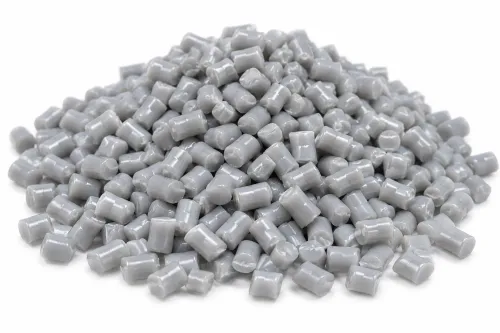
 | GREY MASTERBTACH ₹160 GREY 12006 IS A LIGHT GREY MASTERBATCH. IT IS CLEAR,SHINE GREY TONING MASTER BATCH WITH EXCELLENT DISPERSION AND ESILY COMPATIBLE WITH PE PE RESIN.IT... View product → |
 | masterbatches High-Quality Black Masterbatch Manufacturers and Supplies in India. Khetan Polytex is one of the leading black masterbatch manufacturers in India. View product → |
Frequently asked questions
How do you choose a masterbatch carrier for irrigation pipe resin?
Match the carrier to the base polymer. A PE carrier suits compatible HDPE, LDPE and PE blends, while a film-grade carrier can cause streaks, surface defects, altered melt strength or poor fusion in HDPE pipe.
How should you control masterbatch dosing during pipe extrusion?
Set the let-down ratio before the trial and control the extrusion feed so the masterbatch remains consistent throughout production. Record the ratio, feed settings and resin grade.
How do you check colour consistency in an irrigation pipe coil?
Define an approved colour reference, inspect the pipe under consistent lighting and examine the entire coil for streaks, bands, shade changes and surface defects.
What outdoor durability tests should irrigation pipe masterbatch undergo?
Test the coloured pipe at the actual irrigation exposure, including sunlight, moisture and temperature conditions. Review colour retention and physical performance after exposure.