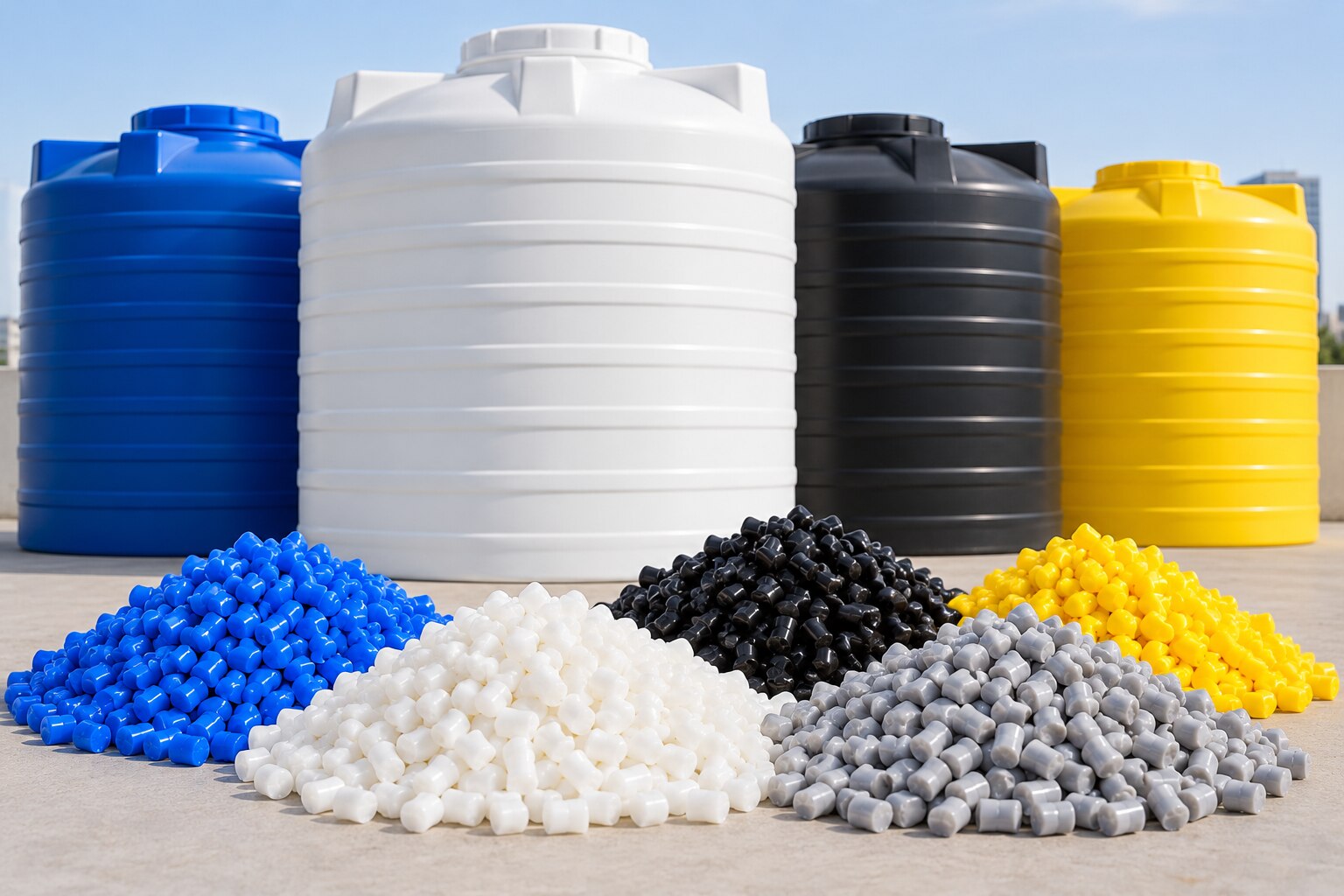
A tank’s visible shade does not tell you whether its walls will resist sunlight, heat and long-term outdoor exposure. By the end, you will be able to specify the colour, resin compatibility, dosage, test evidence and acceptance limits needed for a reliable tank formulation.
Key takeaways
- Treat colour, light fastness and UV stabilisation as separate requirements.
- Match the masterbatch to the tank resin, process and wall structure.
- Set dosage with a controlled trial and calculate cost per finished tank.
- Test specimens moulded like the tank before approving outdoor performance.
Separate the colour brief from the outdoor-performance brief
Choose the colour requirement first, then set outdoor performance targets; a colour masterbatch is not automatically a UV stabiliser. Colour defines appearance, branding, visual inspection and regional market requirements, while light fastness measures fading, weathering resistance covers appearance and physical retention, and UV stabilisation limits polymer degradation.
| Colour | Practical meaning | Check before approval |
|---|---|---|
| Black | Strong light blocking and low visible dirt; heat absorption can raise tank temperature | Confirm pigment, UV package and wall-temperature limits; a black water tank is not automatically algae-proof |
| White | High reflectance and easier surface inspection; lower solar heat absorption than dark colours | Confirm opacity, dirt visibility and outdoor fading; a white water tank construction and safety features comparison in USA-like climates for hot and cold areas, including MS, still requires material-specific testing |
| Grey | Neutral appearance and useful visual inspection | Confirm whether the shade masks cracking, chalking or contamination |
| Blue | Common market and branding choice | Request measured fade and weathering results, not a colour chip alone |
| Green | Landscaping or regional branding | Check pigment light fastness because bright organic pigments can fade |
| Orange | High visibility and strong brand differentiation | Confirm pigment stability, bleed resistance and heat effects |
Algae control expectations need a separate decision: darker or opaque walls can reduce light transmission, but colour alone cannot prove algae control. In Rajasthan, prioritise heat absorption and prolonged sunlight; coastal regions require weathering and moisture exposure evidence; Northeast markets may need performance across humid, cloudy and cooler conditions.
Urban branding can justify a custom shade, but not weaker stabilisation.
Request these data for the actual resin and process:
- pigment identity, light-fastness rating and weathering limit
- UV-stabiliser type, including HALS, absorber or carbon black, and dosage
- plaque or tank-section results at the intended thickness and cycle
For prolonged sun, add a compatible stabiliser package; colour masterbatch alone is insufficient.
Match the masterbatch to the resin, moulding process and tank structure
1. Confirm the exact polyethylene grade before approving the colourant. LLDPE, HDPE and MDPE differ in melt flow, density, crystallinity and stress-crack resistance, so a masterbatch suited to one is not automatically compatible with another. Ask the supplier for the carrier resin, recommended resin grades, MFR, density and processing-temperature range.
2. Use compatibility confirmation methods that match the failure risk: compare MFR and density, examine melting and crystallisation behaviour with DSC, then check tensile properties and environmental stress-crack resistance (ESCR) after compounding.
A large MFR shift, new DSC peak, tensile loss or ESCR reduction signals a formulation problem; none of these tests replaces a trial in the actual tank process.
3. Match the product to the moulding route and thermal exposure. For rotational moulding, request powder masterbatch particle size and instructions for dry blending versus a precompound. Poor dispersion during the long heat cycle creates streaks, specks and locally weak UV protection.
For blow moulding, verify melt strength, parison stability and pinch-off behaviour; for injection-stretch blow moulding, verify stretch orientation and thermal history. Do not transfer data from injection moulding without evidence.
4. For a multilayer tank, specify the inner, intermediate and outer layers separately. Confirm layer thickness, adhesion, weld or moulding integrity, and whether each layer contacts potable water. The complete formulation—pigment, stabiliser, processing aid and carrier—must meet the applicable contact rule, such as NSF/ANSI/CAN 61, Regulation (EU) No. 10/2011 or AS/NZS 4020.
Test the intended wall thickness and process cycle.
Establish dosage through a controlled trial and calculate the real tank cost
Set the let-down ratio with a controlled trial, not from plaque colour alone. Start within the supplier’s recommended addition rate, then run a dosage ladder using supplier-specified increments. Keep the same resin grade, mould, component design, wall thickness and moulding cycle; otherwise a colour change can hide a process change.
- Record the let-down ratio, pigment concentration, resin mass and masterbatch mass for each trial.
- Weigh the empty mould, finished tank and rejected tank to calculate actual component mass.
- For rotational moulding, record oven temperature or air temperature, heating time, torque or internal-air-temperature data, fusion quality, pinholes and wall-thickness variation.
- For blow moulding, record melt pressure, head temperature, parison stability, programming settings and cycle time.
- Inspect colour variation across the tank, including streaks, specks and layer-to-layer differences.
- Record scrap quantity, reject reason and rework time at every dosage.
Calculate the material cost after recognising the displaced natural resin. The cost calculation formula is: cost per tank = (natural resin mass × resin price/kg) + (masterbatch mass × masterbatch price/kg), where natural resin mass equals total component mass minus masterbatch mass. Compare this with the original resin-only cost, cycle time and scrap rate.
A higher masterbatch price can still reduce total cost if it shortens the cycle or prevents colour variation; a cheaper dosage fails if it causes incomplete fusion, unstable parison formation or rejected tanks.
Test colour and durability on specimens made like the finished tank
Use tank-like specimens and two independent acceptance gates: appearance and structure. Mould plaques or tank sections with the actual resin, masterbatch concentration, wall thickness and processing cycle; include thick and thin walls and, for multilayer tanks, inner and outer layers. Measure each batch against the colour standard with a spectrophotometer before exposure.
Inspect mouldings for hide, contamination, weld lines and mould-flow marks.
- Specify ISO 4892-2 xenon-arc or ISO 4892-3 fluorescent UV exposure; fluorescent UV exposure and xenon-arc results are not interchangeable. Record irradiance or radiant dose, temperature, humidity, duration and pass/fail limits.
- Set independent limits for colour delta E, chalking and cracking, plus tensile retention and impact retention. A tank can fade while retaining strength, or look acceptable before oxidation causes embrittlement.
- Validate dark colours at the actual service-temperature range: absorbed sunlight raises wall temperature, accelerating oxidation and thermal expansion. For black, check carbon black content and dispersion; ISO 6964 is a benchmark only for pipes, not an automatic tank recipe. For white, compare rutile TiO2 with anatase.
- Test multilayer sections for layer thickness, adhesion and structural integrity, not appearance alone.
| Specimen or result | What it reveals | Acceptance use |
|---|---|---|
| Actual batches | Dispersion and batch-to-batch colour variation | Compare spectrophotometer delta E |
| Thick and thin walls | Uneven UV penetration and cooling history | Set the stricter result |
| Inner and outer layers | Shielding, adhesion and cracking | Approve appearance and structure separately |
| Exposed specimens | Chalking, cracking, tensile and impact loss | Apply the defined pass/fail limits |
Turn the result into a supplier specification and release checklist
Approve the masterbatch against a written specification, not a catalogue shade. Define the tank resin, process, dosage, colour tolerance Delta E, outdoor exposure, water category and recycled content before requesting documents.
1. Request the supplier data sheet stating carrier resin, recommended let-down ratio, processing temperature, pigment identity, UV stabilizer package, and whether it contains HALS, UV absorber or carbon black. Ask for the complete formulation or a confidential composition statement covering pigments, processing aids and additives.
2. Request a certificate of analysis for the proposed batch, plus a certificate confirming batch number, carrier-resin compatibility, batch consistency and recycled content. Reject material with an unidentified batch number or a formulation that changes without written notification.
3. For potable-water tanks, require evidence that the complete formulation meets the applicable requirement: NSF/ANSI/CAN 61, Regulation (EU) No. 10/2011, or AS/NZS 4020. Check migration results for the actual dosage and resin, not the carrier alone.
4. Set independent acceptance limits: colour tolerance Delta E against the approved plaque; weathering data from the specified exposure method; and retained impact/tensile performance after exposure. Colour retention does not prove resistance to cracking or embrittlement.
5. Release production only after a trial confirms dispersion, wall appearance, layer adhesion and moulding performance at the stated dosage. Khetan Polytex Private Limited can be asked for tank-specific data rather than relying on catalogue claims.
Re-test the first production batch against the approved colour standard and retain the records with the lot number.
Related products
 | Khetan Polytex are leading colour master batches manufacturers in India, Jaipur. Colour Masterbatches are used for coloring plastics and their dyes. View product → |
 | GREEN MASTERBATCH ₹158 E 2028 GREEN MASTERBATCH HAS AQUATIC GREEN COLOR SHADE.IT HAS NATURAL FRESH AQUATIC COLOR IMPART TO END PRODUCT. View product → |
Frequently asked questions
Is a colour masterbatch automatically a UV stabiliser?
No. Colour defines appearance, while light fastness measures fading, weathering resistance covers appearance and physical retention, and UV stabilisation limits polymer degradation.
How do you choose a masterbatch for a water storage tank?
Match it to the resin, moulding process and tank structure, then confirm the colour and outdoor-performance requirements through controlled trials and testing.
How should masterbatch dosage be established?
Run a controlled trial across suitable dosage levels, assess the finished colour and performance, and calculate the resulting masterbatch cost per tank.
What should be tested before approving a tank masterbatch?
Test colour and durability on specimens made with the same resin, process conditions and structure as the finished water tank.
Related products
 | masterbatches ₹200 Khetan Polytex is a leading white masterbatch manufacturers that offer products with wide applications in the plastic industry. View product → |
 | ORANGE MASTERBATCH ₹310 ORANGE E 6018 MASTERBATCH IS A STRONG COLOR WITH EXCELLENT HEATING AND WEATHER STABILTY. View product → |
 | GREY MASTERBTACH ₹160 GREY 12006 IS A LIGHT GREY MASTERBATCH. IT IS CLEAR,SHINE GREY TONING MASTER BATCH WITH EXCELLENT DISPERSION AND ESILY COMPATIBLE WITH PE PE RESIN.IT... View product → |
 | WHITE MASTERBATCH ₹210 OUR E 10038 WHITE IS BRIGHTER BLUE LIKE EVEREST WHITE MASTERBATCH. View product → |