A masterbatch that produces the right shade on a colour plaque can still reduce opacity, impair bottle performance, create odour, or fail food-contact requirements after processing. By the end, you will be able to match the concentrate to each container format, set a defensible starting dosage, request the right compliance evidence, and validate the result on your production equipment.
Key takeaways
- Match the carrier to HDPE, PP, LDPE or LLDPE and the moulding process.
- Set colour, opacity and let-down ratio targets before requesting samples.
- Request finished-article food-contact documentation, not only raw-material declarations.
- Run a production trial to check dispersion, heat stability, sealing and bottle strength.
Match the Masterbatch to the Container Format and Resin
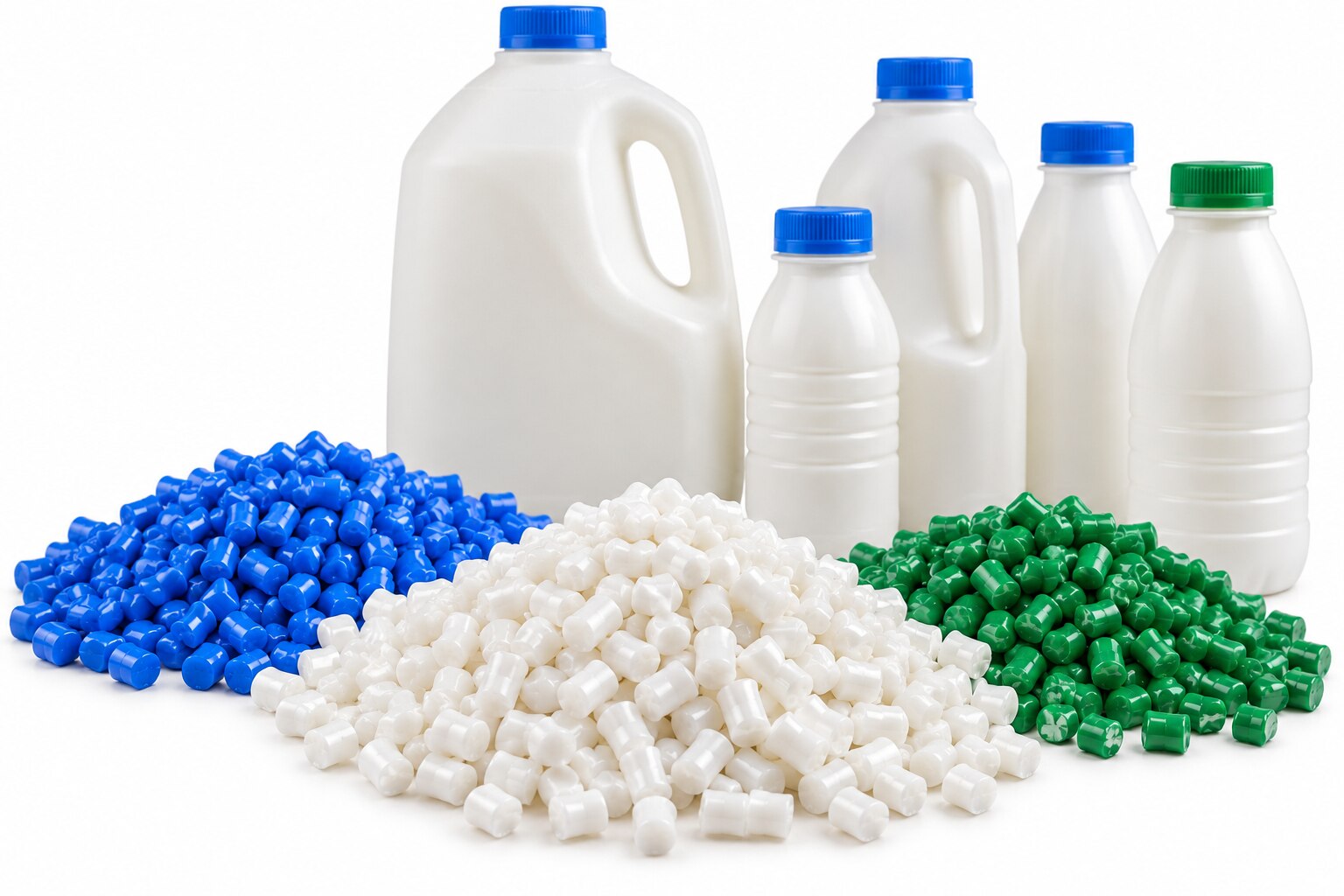
Start with the resin and process, not the colour alone. For milk containers, specify whether the masterbatch is for extrusion blow moulding HDPE milk bottles, injection-moulded caps, multilayer containers or flexible pouches, then match its carrier to the actual polymer: HDPE, PP, LDPE or LLDPE.
| Format and process | Resin to match | Design concern |
|---|---|---|
| Extrusion blow-moulded bottle | HDPE, including the specified PCR content | Preserve melt strength, ESCR, drop impact and top-load performance |
| Injection-moulded cap or closure | PP or the specified HDPE grade | Avoid weld-line weakness, mould deposits, poor hinge action or incorrect opening torque |
| Multilayer bottle or pouch | The polymer layer receiving the colour | Confirm adhesion, dispersion and compatibility with neighbouring layers |
| Flexible milk pouch | LDPE or LLDPE film structure | Prevent gels, streaks, blocking and loss of seal strength |
A bottle concentrate is not automatically suitable for a cap: the different moulding cycle and rheology can expose defects that extrusion blow moulding hides. Poor carrier compatibility can cause die build-up, gels, streaks or reduced impact and environmental-stress-crack resistance.
If post-consumer recycled HDPE is included, qualify the concentrate against its actual colour, melt flow, odour and contaminant variation; a shade that works in virgin resin may not cover PCR consistently.
Set Shade, Opacity and Dosage as Measurable Targets
A white masterbatch is the usual starting point for HDPE milk bottles, but choose the shade against a measured colour target and opacity requirement. Specify light transmission or contrast ratio, not a visual match alone: weak opacity allows light through and can accelerate quality loss in light-sensitive milk constituents.
| Shade | Practical advantage | Main trade-off |
|---|---|---|
| White | Strong perceived cleanliness and high hiding power | Can require higher pigment loading |
| Ivory | Masks recycled-content variation and gives a warmer appearance | May look dull or yellow against the closure |
| Blue-tinted milk packaging | Creates a cooler, brighter perceived white at low tint levels | Excess blue becomes visibly grey and complicates colour control |
For an initial production trial, test 2–4% white masterbatch and 1–3% ivory or blue-tint masterbatch, then adjust in 0.25–0.5% steps. Confirm the actual let-down against bottle-wall thickness, resin whiteness, pigment concentration and opacity; a nominal colour code does not set dosage.
Excessive loading can raise melt viscosity, worsen dispersion and produce specks or weak thin sections.
Request the titanium dioxide grade and carrier details. Rutile TiO₂ with suitable surface treatment is generally preferred for durable white packaging, but verify dispersion in the selected resin. Do not add UV stabilisers automatically; measured exposure, shelf-life results and food-contact assessment must justify them.
Check Finished-Article Food-Contact Compliance
Food-contact suitability belongs to the finished milk container, not just the colour concentrate. The carrier, base resin, pigment, additives, dosage, processing heat and any other layer or closure can change migration, so a “food grade” masterbatch claim is not enough.
Request evidence that identifies the complete formulation and intended use:
- A Declaration of Compliance naming EU Regulation 10/2011, the applicable substance restrictions, specific migration limits, overall migration limit and test conditions for milk contact.
- A migration test report for the finished bottle, cap or pouch structure, using the intended resin, masterbatch let-down, wall thickness and food simulants—not only a masterbatch sample.
- A United States compliance assessment identifying the polymer authorisation, including FDA 21 CFR 177.1520 for applicable olefin polymers, plus the separate FDA status of pigments and additives.
- Formulation and change-control records showing that the tested article matches the production recipe, including recycled HDPE if used.
- Organoleptic or sensory results covering odour and taste under the intended milk-contact conditions.
A supplier’s certificate of analysis proves batch identity or test values; it does not prove finished-article compliance. Recheck the assessment after changing resin, dosage, additive package, layer structure or processing conditions.
Control Heat History, Feeding and Dispersion on the Machine
A stable run starts with a stable melt history. Set melt temperature for the resin and carrier, then log actual barrel and die readings; controller setpoints can miss hot spots. Excess heat or residence time can increase odour, darken shade and degrade polymer. Excessive screw shear can raise viscosity or leave poorly dispersed pigment.
Keep purge and shutdown practice consistent.
Use this check:
- Calibrate the gravimetric feeder at intended throughput and verify the let-down ratio by weighing output. Volumetric feeders drift when bulk density changes, pellets bridge or fines alter flow.
- Specify pellet-size range, fines, moisture and contamination limits. Segregation causes dosing error; fines foul conveying lines and create specks.
- Sample start-up, steady-state and end-of-run bottles. Compare colour, opacity, wall defects and odour using the intended milk-contact sensory protocol.
- Hold screw speed, back pressure, cooling and blow-moulding cycle constant; change one variable at a time.
| Control | Preferred choice | Failure if uncontrolled |
|---|---|---|
| Dosing | Gravimetric calibration | Shade drift |
| Thermal history | Logged melt temperature and residence time | Odour or degradation |
| Dispersion | Sufficient screw shear without overheating | Specks or weak areas |
Validate Bottle Performance, Recycling and Special Additives
Use paired trials on the finished bottle: the selected let-down against an uncoloured control, with identical resin, geometry and processing conditions. A colour plaque cannot reveal how pigment or filler has changed crystallisation, stiffness, melt strength or defect sensitivity.
Run these mechanical checks on production-geometry bottles:
- ESCR using the intended detergent or chemical exposure and the specified test duration.
- Drop impact at the required fill condition and test temperature.
- Top-load performance under the stacking load and duration the distribution system imposes.
If post-consumer recycled HDPE is included, qualify the masterbatch against its real range of colour, melt flow, odour and contaminant load. Virgin-HDPE approval does not prove acceptable hiding, streak-free dispersion or stable colour in recycled resin, and colour matching does not establish food-contact authorisation.
Test odour and taste with the intended milk-contact conditions, carrier, additive package, processing temperature and residence time. Compare filled packs with the uncoloured control under a documented sensory or organoleptic protocol. For dark shades, require compatibility with the planned near-infrared sorting system; standard carbon black can make containers invisible to optical sorters and cause mis-sorting.
Qualify caps separately because their resin and moulding stresses differ from the bottle’s.
Compare Suppliers Through Documents and a Production Trial
Request a certificate of analysis for the proposed lot, a technical data sheet, a safety data sheet and a batch traceability record before scheduling trials. Also ask for the carrier resin, pigment or additive loading, recommended let-down range, processing-temperature limits, food-contact documentation and change-notification procedure.
- Calibrate the gravimetric or volumetric feeder at the intended throughput. Record actual dosing against the setpoint; bulk-density changes, bridging and poor flow can shift colour without changing the machine setting.
- Run the trial using production resin, bottle geometry and normal cycle conditions. Keep the masterbatch lot, dosage, melt temperature and screw or extrusion settings fixed.
- Save start-up, steady-state and end-of-run bottles. Measure shade, opacity or light transmission, wall-thickness coverage, specks, streaks, bottle weight and rejection rate.
- Repeat drop, top-load and environmental-stress-cracking checks on trial bottles before approval.
| Evidence | What to compare | Approval question |
|---|---|---|
| Certificate of analysis | Assay, colour values, moisture and lot number | Does the delivered lot match the specification? |
| Technical data sheet | Carrier, dosage, temperature window and storage | Will it run in your resin and process? |
| Safety data sheet | Handling, hazards and spill controls | Can your plant manage it safely? |
| Batch traceability record | Raw-material and production-lot links | Can defects be traced quickly? |
Khetan Polytex Private Limited is one supplier to include in the same comparison, using identical resin, equipment settings and acceptance limits rather than judging samples by appearance alone.
Related products
 | YELLOW MASTERBATCH ₹175 IVORY E-5010 IS BRIGHT OPACKED IVORY COLOR WITH HIGH LIGHT FASTNESS FOOD GRADE MASTERBATCH. View product → |
 | masterbatches High-Quality Black Masterbatch Manufacturers and Supplies in India. Khetan Polytex is one of the leading black masterbatch manufacturers in India. View product → |
Frequently asked questions
Which masterbatch carrier is suitable for milk containers?
Match the carrier to the container resin and process: HDPE for extrusion blow-moulded bottles, PP for caps, and LDPE or LLDPE for flexible pouches.
How should you specify masterbatch dosage for a milk container?
Define a target let-down ratio, shade, opacity and acceptable colour tolerance, then confirm the result on the actual resin and machine.
What food-contact documents should you request?
Ask for a declaration covering the intended food-contact application, supported by composition and migration information for the finished article and the destination market.
How do you test masterbatch performance before approval?
Run it on the intended production equipment and inspect dispersion, heat history, colour consistency, bottle strength, sealing, odour and process stability.
What should you compare between masterbatch suppliers?
Compare carrier compatibility, technical data, food-contact documentation, batch traceability, recommended dosage, trial support and consistency across production batches.
Related products
 | Desiccant Masterbatch ₹55 Desiccant Masterbatches can counter problems that develop during the processing of plastics due to the presence of moisture and prevents the... View product → |
 | masterbatches ₹200 Khetan Polytex is a leading white masterbatch manufacturers that offer products with wide applications in the plastic industry. View product → |
 | BLUE MASTERBATCH E 1098 ₹198 BLUE COLOUR MASTERBATCH CODE OF PRODUCT: E 1098 HEAT STABILITY: 260° CELCIUS LIGHT FASTNESS: 7 ULTRA BLUE SHADE OF BLUE MASTERBATCH WITH VERY GOOD... |
 | Khetan Polytex are leading colour master batches manufacturers in India, Jaipur. Colour Masterbatches are used for coloring plastics and their dyes. View product → |