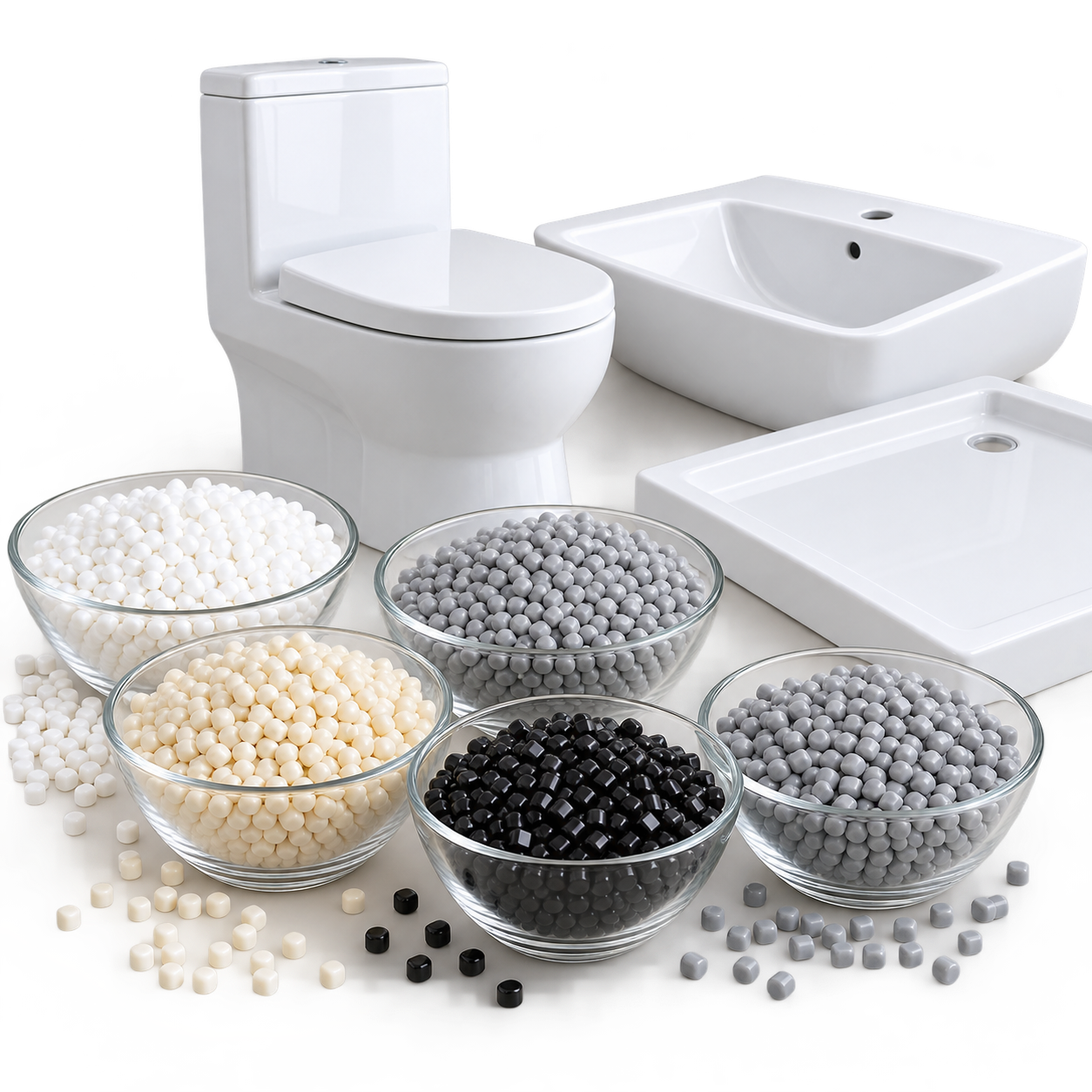
A sanitary-ware part can leave the mould with the right colour yet still show gloss bands, streaks, specks, weld-line changes or visible shade variation. The key is to control the masterbatch, polymer, moisture, dosing and moulding conditions as one system, then approve colour and surface finish with defined measurements rather than visual judgement alone.
Key takeaways
- Dry moisture-sensitive resin to its specified grade temperature and time.
- Match the carrier resin and verify dosage across the processing window.
- Approve shade and gloss against physical reference panels and measured values.
- Check drying, mixing, purging and mould conditions before changing formulation.
Start with the right resin, carrier and addition rate
1. Dry the base resin to its grade specification before blending. Polyamide, PET, PBT and some PC grades absorb moisture; inadequate drying causes hydrolysis, bubbles and silver streaks that look like poor pigment dispersion. Dry the masterbatch too when its supplier specifies it.
2. Set the addition rate with this addition rate formula: masterbatch mass ÷ total melt mass × 100. Thus, 2 kg of masterbatch in a 100 kg polymer blend gives a 2% let-down.
Let-down is not active pigment concentration: a 50% pigment masterbatch at 2% addition contributes approximately 1% pigment before carrier, additives and regrind are considered.
Use the recommended let-down range for masterbatch as a trial starting point, not a universal specification:
- Strong pigments: approximately 0.5–1.5%
- Standard colour depth: approximately 1–3%
- High-opacity white systems: approximately 2–5%
- Mineral-filled formulations: approximately 10–30%
3. Match the carrier to the base resin and processing temperature. Use a carrier from the same polymer family for polypropylene, polyethylene, ABS, SAN or PVC; for an engineering resin, require compatibility data at the intended dosage. A mismatched carrier creates streaks, specks, weak weld lines or lost gloss.
Mineral fillers also change viscosity, shrinkage, stiffness, reflectivity and dimensions.
4. Calibrate a gravimetric feeder with the actual pellets, especially at low let-down ratios, because pellet density, shape, vibration and hopper level distort volumetric dosing. Blend, mould first-off parts, inspect shade, gloss, specks and surface uniformity, then release the run only after approval.
Control the variables that turn colour consistency into finish consistency
A correct let-down can still produce streaks, swirls, specks, shade bands, weld-line colour changes or uneven gloss. Surface finish versus colour consistency depends on pigment dispersion, carrier compatibility and the full moulding window, not colour dosage alone.
Control these variables together:
- Set screw speed, back pressure, melt temperature and residence time to disperse pigment without overheating it. Excessive heat, dead spots or repeated processing can yellow the carrier or pigment.
- Match injection speed, mould temperature and cooling time to the resin. Local shear, uneven cooling and unbalanced cavities create flow marks and gloss bands.
- Check gate location, venting and cavity balance. A weld line can change colour because two flow fronts meet with different thermal and orientation histories.
The polymer skin reproduces the cavity surface. Uneven polishing or texture, release-agent residue and a damaged cavity therefore remain visible; adding masterbatch cannot correct them.
White systems need separate selection:
| Grade | Main effect | Risk or use |
|---|---|---|
| Rutile titanium dioxide | Higher refractive index and hiding power | Check treatment and dispersion for gloss, undertone, weathering and yellowing |
| Anatase titanium dioxide | Lower hiding power and different undertone | Use only after confirming the required appearance and durability |
Fillers change viscosity, shrinkage, stiffness, reflectivity and dimensions, so a filled white part needs its own moulding and dimensional qualification. Dry polyamide, PET, PBT and some PC grades to the processor’s moisture limit and verify moisture; excess water causes splay, silver streaks, bubbles and defects mistaken for pigment agglomerates.
Define recycled-resin percentage, colour segregation and heat-cycle limit before production.
Approve both colour and gloss with a measurable standard
A sanitary-ware part is acceptable only when it matches an approved physical sample for both colour and surface gloss. Inspect under controlled lighting at the gate, weld lines, corners, ribs, cavity transitions and other visible locations; a good centre area does not excuse a shade band or dull patch elsewhere.
1. Record instrumental CIELAB L*a*b* readings for the approved sample and trial parts. Set a written Delta E tolerance and use ASTM D2244 to calculate colour difference under the same illuminant, observer angle, instrument geometry and backing. Visual approval alone is not a reproducible standard.
2. Approve gloss separately from colour. Use ASTM D523 gloss measurement at 60° for general-purpose surfaces, 20° for high-gloss sanitary surfaces and 85° for low-gloss surfaces. A part can match colour yet fail gloss because of mould polish, texture, flow orientation or pigment dispersion.
3. Run a small colour drawdown or moulding trial, compare every cavity, inspect repeated shots after purging and approve both colour and gloss before release. Record the sample, cavity, machine settings, readings and acceptance limits.
4. For an outdoor cistern, bath panel or exposed accessory, agree an ISO 4892-2 xenon-arc cycle, exposure duration, allowable colour change and minimum gloss retention before testing. Do not treat light fastness, heat stability, chemical resistance or migration as interchangeable claims; qualify each property with its own test and limit.
Compare supply formats and request evidence before committing
Choose the format that controls variation without creating excessive changeover waste. The masterbatch versus pre-coloured resin decision depends on whether you value flexible shade changes, minimum dosing error or immediate batch uniformity.
| Format | Dosing and storage | Cleaning, changeover and repeatability |
|---|---|---|
| Masterbatch | Accurate with gravimetric feeding; stores as pellets but needs compatible resin and controlled addition | Low retained material; repeatable after calibration, with some purge waste |
| Pre-coloured resin | No colour dosing; requires more shade-specific inventory | Minimal colour adjustment, but unused resin remains tied to one shade |
| Liquid colour and dry pigment comparison | Liquid systems need pump calibration and spill control; dry pigment is difficult to meter and disperse consistently | Liquid cleanup can be prolonged; dry pigment creates dust and contamination during changes |
| Compound | Highest uniformity and simplest feeding; stores as finished material | Lowest formulation flexibility and greater retained stock; changeovers still consume purging material |
Request a supplier technical data sheet and safety data sheet before a trial. Also obtain:
- Carrier-resin declaration confirming compatibility with your polymer
- Pigment or additive composition, recommended processing temperature and dosage range
- Lot traceability and a certificate of analysis for each batch
For parts contacting water, cleaners or skin, request extraction or migration data, chemical-resistance results and the regulatory or application documentation named for that use. Treat colour retention separately from antimicrobial performance: an ISO 22196 result must identify the organisms, contact conditions and test method.
Slip agents and other migratory additives can produce haze, deposits or local gloss changes after heat exposure, conditioning or ageing. Khetan Polytex Private Limited can be compared with other suppliers for technical support, but qualify the exact polymer, dosage, processing window, evidence and sanitary-ware application; no supplier name replaces grade-specific approval.
Related products
 | Khetan Polytex are leading colour master batches manufacturers in India, Jaipur. Colour Masterbatches are used for coloring plastics and their dyes. View product → |
 | FILLER MASTERBATCH Most Reliable Filler Masterbatch Manufacturers in Jaipur, India We have been continuously innovating their product lines to keep up with the demands... View product → |
Troubleshoot shade mismatch before changing the formulation
Do not raise pigment concentration first. Begin a shade mismatch investigation by proving whether the material, dosing system or moulding process changed.
1. Confirm the base-resin lot, masterbatch lot, regrind percentage and lot traceability. Regrind needs a defined percentage, compatible-colour segregation and a heat-cycle limit; uncontrolled regrind changes shade, gloss and surface history.
2. Check feeder calibration with the actual resin and masterbatch pellets, then verify hopper blending uniformity and pellet segregation. Low let-down ratios expose errors in pellet bulk density, vibration and hopper level.
3. Test resin and masterbatch moisture, dryer performance, melt temperature, screw speed, back pressure, residence time, barrel dead spots and purging history. Thermal damage can yellow, darken or streak a part.
4. Check mould temperature, cooling time, gate balance and cavity condition. Uneven polishing, texture, venting, release-agent residue or weld lines create gloss bands and shade differences that extra pigment cannot correct.
Increasing pigment before these checks can mask a dosing or process fault, then create a second mismatch when the fault is corrected.
A colour change creates colour-change waste: purging compound, discarded start-up parts, hopper and screw cleaning, retained pellets and the time required to reach a stable shade.
Masterbatch is the wrong choice for transparent parts needing optical clarity, highly exact matches better served by a compound, severe chemical exposure without migration and resistance evidence, uncontrolled recycled content, or an incompatible carrier system.
Approve the replacement only after checking colour, gloss, dimensions, chemical-exposure performance and aged appearance—not colour alone.
Frequently asked questions
How do resin choice and addition rate affect sanitary ware finish?
Use a masterbatch with a carrier compatible with the base resin, then verify the recommended addition rate through trials. An unsuitable carrier or excessive dosage can affect dispersion, shade, surface appearance and processing.
Which process variables affect colour and gloss consistency?
Control resin moisture, melt temperature, screw speed, back pressure, residence time, mould temperature, cooling and purging. Keep these settings consistent between approval samples and production parts.
How should you approve colour and gloss in moulded sanitary ware?
Use an approved physical reference panel under defined lighting, then record instrumental colour values and gloss measurements at fixed viewing angles. Inspect the same part locations for every comparison.
What should you check before changing a masterbatch formulation?
Confirm the batch number, dosage, resin drying record, blend uniformity, machine settings, mould condition and purge history. Compare samples from the same cavity and production stage before reformulating.
Related product
 | masterbatches ₹200 Khetan Polytex is a leading white masterbatch manufacturers that offer products with wide applications in the plastic industry. View product → |