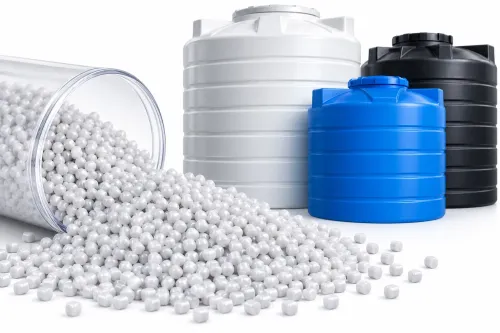
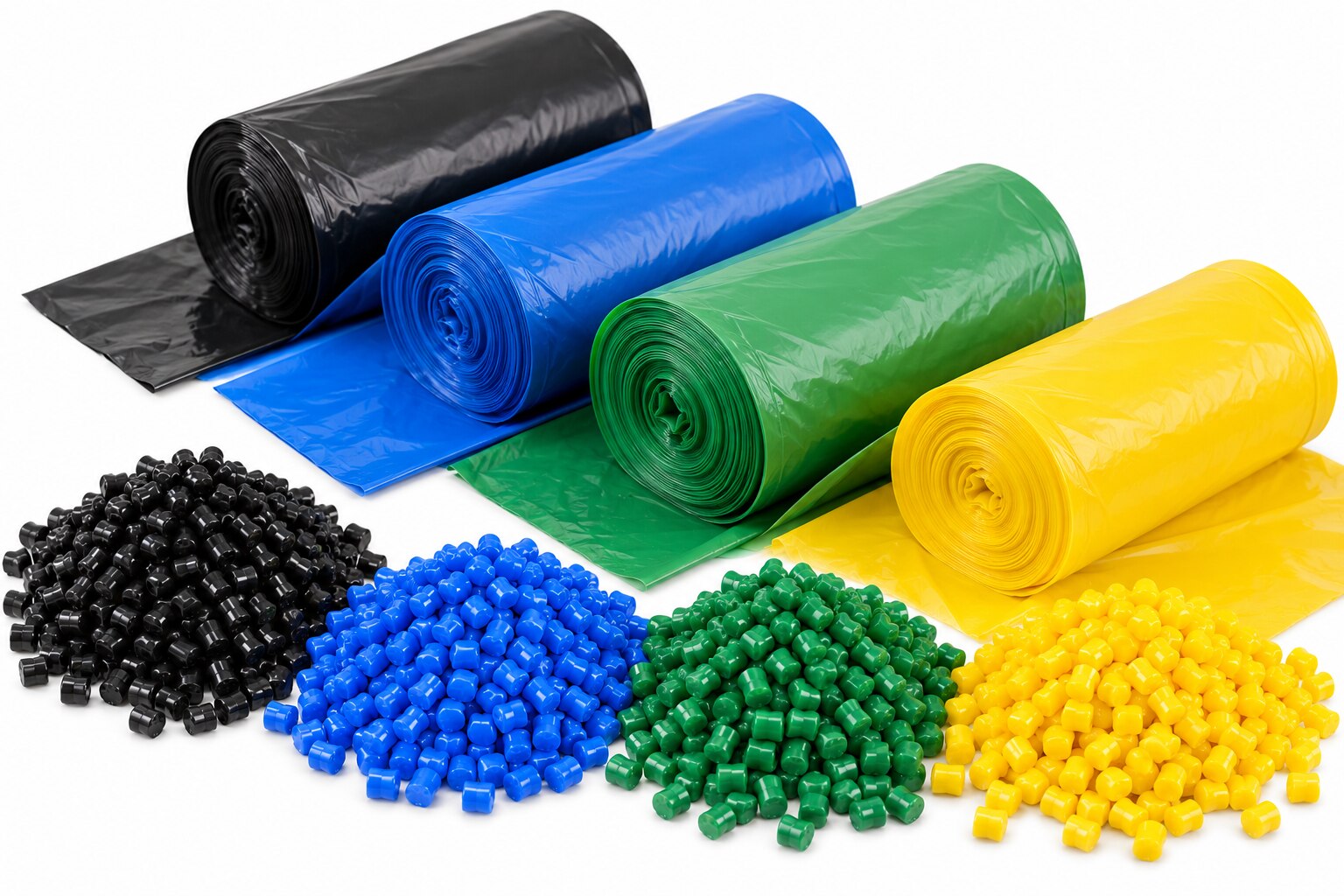
A garbage-bag film can leave the die with the right colour and still fail through streaks, specks, gauge-related shade shifts, weak seals or unstable output. By the end, you will be able to choose a compatible carrier, set and calculate a trial dosage, verify colour with measurable tolerances, and connect masterbatch performance to extrusion and bag-quality checks.
Key takeaways
- Choose a compatible PE carrier instead of relying on melt-flow rate alone.
- Calculate let-down from the required pigment concentration and verify feeder accuracy.
- Approve colour using film measurements alongside visual samples.
- Retest dispersion and processing when recycled resin, filler or slip additives change.
Choose the carrier and set a defensible starting dosage
Start with a polyethylene carrier that melts and mixes cleanly in your film formulation, not one selected by nominal melt-flow rate alone. A garbage bag masterbatch for LLDPE or LDPE should use a compatible PE carrier and have melt-flow behaviour suited to your resin, die temperature and screw mixing.
Matching MFR alone does not guarantee dispersion; pigment loading, pellet size, carrier chemistry and mixing history also matter.
| Film resin | Carrier choice | First trial dosage |
|---|---|---|
| LLDPE | LLDPE-compatible PE carrier with stable dispersion at your extrusion temperature | 3% of total blend |
| LDPE | LDPE-compatible PE carrier, checked for die pressure and melt strength | 3% of total blend |
| Recycled polyethylene | Compatible PE or recycled polyethylene carrier resin, validated against feedstock variation | 3–5% of total blend |
Trial 2–5% masterbatch by total blend weight. Begin at 3%: 3 kg of masterbatch with 97 kg of base resin gives a 100 kg trial batch. Use 2% when pigment strength and opacity are already adequate; move toward 5% when the recycled feedstock has strong colour variation or the film needs higher opacity.
Recycled polyethylene can bring changing hue, MFR, contamination, odour and previous additives. Colour masterbatch can correct shade, not gels, incompatible polymers or unstable melt flow. Compare the 3% trial with 2% and 5% samples, then select the lowest dosage that meets colour and processing requirements.
Calculate the let-down and control what actually enters the extruder
A 2% let-down ratio means 2 kg of masterbatch in every 100 kg of finished blend, so 98 kg is resin. For 500 kg of virgin resin, calculate masterbatch as 500 × 2 ÷ 98 = 10.2 kg.
Do not multiply virgin resin weight by 2% unless your specification defines the ratio against resin rather than total blend.
For a continuous line, calculate mass rates from the required film output. At 100 kg/h total film output and a 2% masterbatch dosage, the target is 2 kg/h of masterbatch and 98 kg/h of resin. A “50% pigment” concentrate at that dosage contributes about 1% pigment; compare active pigment content, not only the feeder percentage.
Prevent volumetric settings from disguising dosing errors. Pellet bulk density changes with fines, shape and bridging, so a feeder set to 2% is not proof that 2% entered the extruder.
- Use gravimetric dosing for tight colour tolerances, or verify loss-in-weight feeders at a defined interval.
- Collect and weigh each feeder’s discharge during a timed catch test; compare actual kilograms per hour with the calculated rate.
- Record the masterbatch lot, feeder rate, resin rate and film output on the production sheet.
- Stop and investigate if the measured rate differs from the agreed tolerance; correcting shade downstream cannot repair an incorrect formulation.
Judge economy by the cost per unit of acceptable film, since a lower masterbatch dosage can demand tighter control or a stronger pigment package.
Approve colour with film measurements, not visual comparison alone
Prove consistency by comparing instrument readings from defined samples across the run, not by holding film against changing backgrounds. Thin or translucent garbage-bag film can look lighter over white backing and darker over black, while gauge variation changes measured colour even when pigment dosing is stable.
Set one reference method and keep it unchanged between approval and production checks:
- Record film thickness beside every colour reading. Correlate gauge data with L*, a*, and b* changes to separate shade shifts from thickness effects.
- Place every specimen over the same backing material, because a backing change can alter the apparent shade and the measured result.
- Configure the spectrophotometer with the same illuminant, observer angle, and measurement geometry for every reading.
- Sample the left, centre, and right positions across the web at the beginning, middle, and end of the run. Record each result rather than relying only on an average.
- Express the approved target and production readings in CIELAB, then calculate Delta E against the target.
- Keep a retained sample from the approved trial and set the Delta E tolerance before production starts.
A run passes when readings from all defined positions remain within that Delta E tolerance and thickness stays within its process range. If colour falls outside the limit, check gauge variation, feeder output, dispersion, and backing before changing pigment dosage; adding colour can hide a measurement problem rather than fix it.
Link dispersion and thermal stability to blown-film settings
Streaks, specks, gels, die lines and shade variation usually indicate unstable feeding, poor pigment dispersion or overheated material—not simply an incorrect colour formula. Check the machine before increasing pigment concentration; excess loading can intensify agglomeration and raise melt pressure.
- Clean the hopper, throat, feed screws and magnet before the trial. Residual black, filler or degraded polymer can create false specks and contaminate the shade.
- Record pre-mixing time for resin and masterbatch. Inadequate blending produces local concentration differences; excessive mixing can separate pellets by size or density.
- Confirm the PE carrier suits the film resin, then monitor screw back pressure, screen-pack pressure and output. Rising pressure points to agglomerates, contamination or degradation.
- Record melt temperature at the die, not only the barrel setpoint. Compare it with the masterbatch’s processing and thermal-stability data, and avoid unnecessary residence time.
| Film symptom | Extrusion check | Likely finding |
|---|---|---|
| Streaks or local shade change | Sample across the roll width; inspect feeding and mixing | Poor pigment dispersion or uneven dosing |
| Specks or gels | Inspect pellets, hopper and screen-pack pressure | Contamination, agglomerates or degraded polymer |
| Die lines | Check die lips, die build-up and pressure trend | Deposits or incompatible carrier |
| Shade drift | Compare start, middle and end samples by spectrophotometer | Thermal degradation, feed segregation or recycled-resin variation |
Verify stability by running the masterbatch at the actual film-processing temperature and normal residence time, then compare pressure, torque, film appearance and colour against an early sample. Repeat at the highest planned temperature; darkening, gas, gels or rising pressure disqualifies the setting.
Compare the finished film when recycled resin, black, filler or slip additives are involved
Judge the formulation on conditioned finished film, not on a plaque made from another resin. Compare it with an approved control at the same thickness, then record colour, haze, tensile strength and dart impact alongside tear, seal strength and coefficient of friction.
| Option | What can change | What to check before approval |
|---|---|---|
| Recycled polyethylene | Base shade, melt flow, gels, odour and previous additives can shift colour and processing | Run a retained-feedstock trial; reject a formulation that hides shade variation but leaves gels, weak spots or unstable output |
| Carbon black masterbatch | Dispersion affects jetness, opacity, electrical behaviour and UV protection | Inspect for specks and streaks, then test opacity and exposed-film stability rather than judging blackness alone |
| Calcium carbonate filler | Higher loading can raise stiffness and density while reducing elongation, tear resistance or dart impact | Set limits for the bag’s duty; check extrusion pressure, seal response, tensile strength and dart impact at production thickness |
| Slip and antiblock | Surface migration changes handling, blocking and friction after production | Test freshly made film and film after a defined conditioning interval, including seal strength and winding behaviour |
Accept the lowest-cost formulation that keeps every result inside your customer limits. The lowest dosage is not automatically cheapest: added carrier, tighter process control or rejected rolls can outweigh pigment savings. Ask Khetan Polytex Private Limited for film-based comparison data at your resin blend, thickness and conditioning interval, not only colour plaques.
Recycled resin still needs separate controls for feedstock variation.
Frequently asked questions
How do you choose a masterbatch carrier for garbage-bag film?
Choose a compatible polyethylene carrier that melts and mixes cleanly with the LLDPE or LDPE formulation, die temperature and screw-mixing conditions. Do not select it by nominal melt-flow rate alone.
How do you calculate garbage-bag masterbatch dosage?
Use the target pigment or additive concentration and the masterbatch concentration to calculate the let-down ratio, then confirm the actual feed rate entering the extruder.
Why is visual colour comparison insufficient for garbage bags?
Lighting, film thickness and surface gloss can change perceived colour. Measure film colour and compare controlled samples instead of approving shade by eye alone.
How do blown-film settings affect masterbatch performance?
Poor dispersion can result from unsuitable temperature, inadequate mixing or unstable output. Check die temperature, screw mixing, residence time and bubble conditions when evaluating colour and thermal stability.
What should you retest when using recycled resin, filler or slip additives?
Retest shade, dispersion, thermal stability, film strength and processing because recycled resin and additives can change colour, viscosity, surface behaviour and pigment distribution.
Keywords