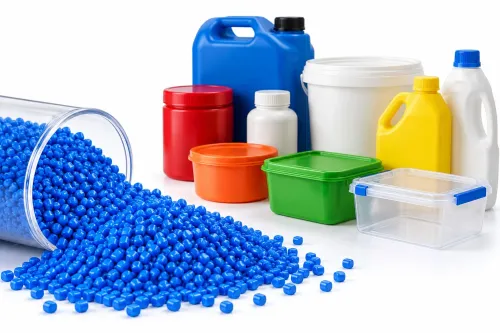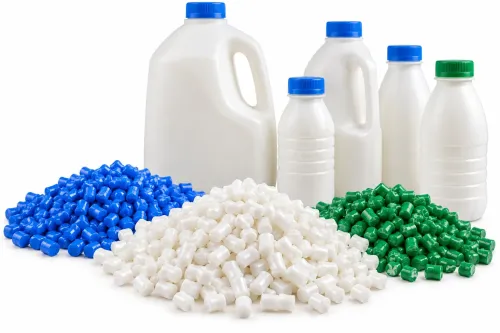
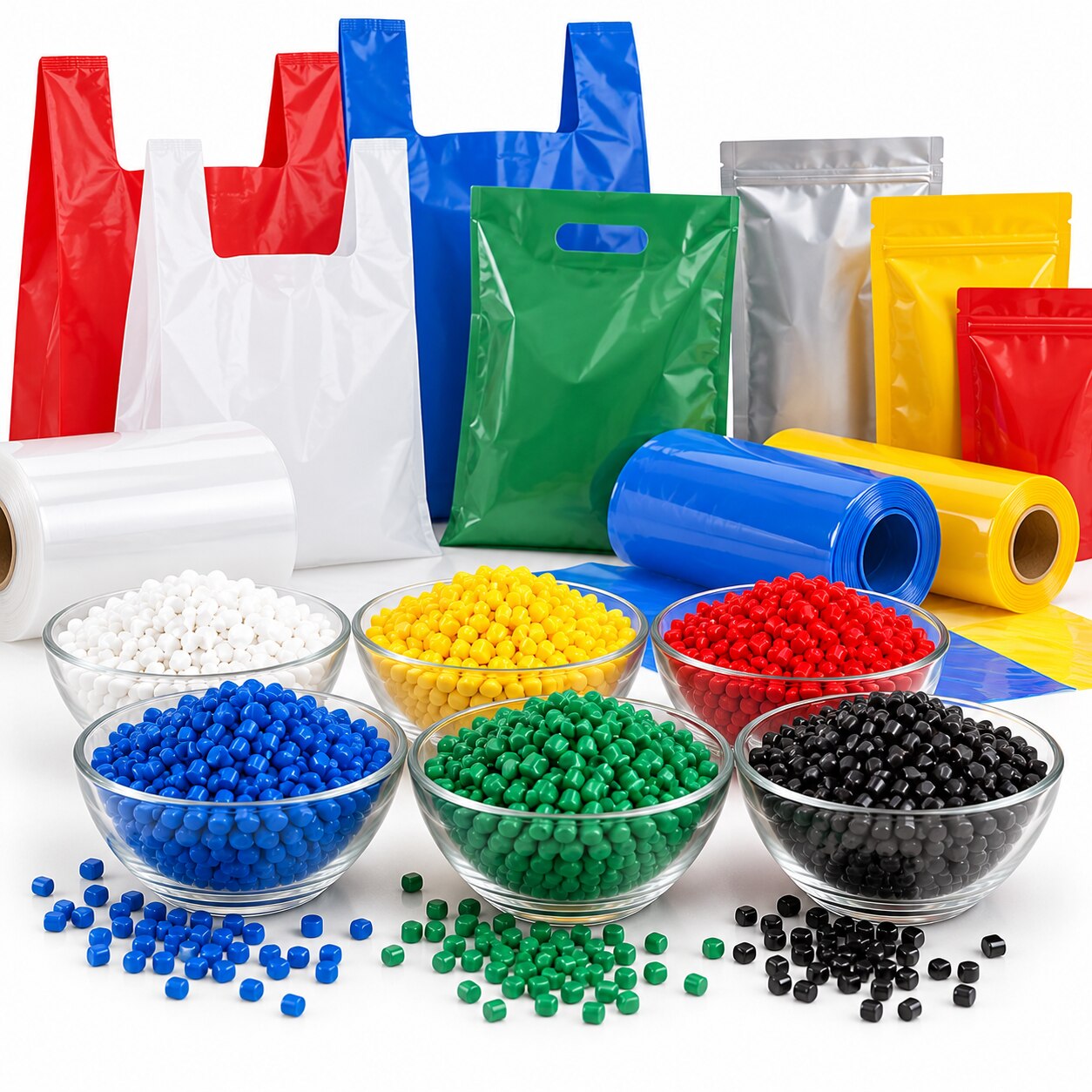
A masterbatch that looks right in pellet form can still cause poor dispersion, weak seals, excess haze or inconsistent colour in a shopping bag. By checking resin fit, process conditions, dosage, controlled film data and documentation, you can compare concentrates on finished-bag performance rather than price or appearance alone.
Key takeaways
- Match the carrier resin to the film resin and extrusion route.
- Calculate the let-down ratio, then verify actual dosing at the extruder.
- Test colour, seal strength, slip and filler effects on controlled film samples.
- Request compliance documents, special-claim evidence and production traceability records.
Match the Carrier and Masterbatch to Your Film Process
Confirm compatibility by matching the masterbatch carrier resin to the film resin and the exact extrusion route, not by matching colour alone. A concentrate designed for LLDPE or LDPE film is not automatically suitable for HDPE shopping bags, PP structures or a multilayer film’s sealant layer.
A mismatch can cause poor dispersion, gels, haze, unstable melt strength and weak seals.
1. Record the resin grade, melt-flow rate, recycled-content percentage and target film gauge. Identify whether the bag uses LLDPE, LDPE, HDPE, a blend or a multilayer structure.
2. Give the supplier the process details: blown-film or cast-film extrusion, mono-layer or coextrusion, die and melt-temperature range, screw configuration, output rate and cooling method. Request compatibility data from trials using the same resin family and processing temperature.
3. For coextrusion, confirm that the carrier will not migrate into or weaken the sealant layer. Test the concentrate in the layer where it will be dosed, rather than approving it from a trial in a different polymer.
4. If the batch contains calcium carbonate or another filler, request filler percentage, particle-size information, moisture data and film results at your intended loading. Excess filler can reduce elongation, tear, dart impact, puncture resistance and heat-seal strength.
Run a short production trial at the planned addition rate, then inspect the film for gels, streaks, haze, blocking, unstable bubble behaviour and seal defects. Compare machine-direction and transverse-direction results; orientation can make a compatible-looking formulation fail in one direction.
Set the Let-Down Ratio and Verify Actual Addition
A 25% pigment masterbatch added at 2% contributes only 0.5% pigment to the film: 0.25 × 0.02 × 100. Calculate active concentration before comparing prices or setting a trial. For filler, use the supplier’s verified filler percentage, not the total masterbatch weight.
Use the first trial to establish the required final concentration, then translate it into an addition rate:
- Addition rate (%) = required active concentration ÷ masterbatch active concentration × 100. A 1% pigment target with a 25% concentrate requires 4% masterbatch, equivalent to a 1:24 let-down ratio.
- Trial at two or three rates around the supplier’s validated range, such as 1%, 2% and 4%, while holding resin, gauge and output constant.
- Confirm the loss-in-weight feeder can meter the selected rate accurately. Very low rates expose feeder resolution errors; excessive rates can change melt flow, additive balance, stiffness, elongation and seal behaviour.
- During production, collect and weigh a timed feeder discharge or compare gravimetric consumption with line output. Record the actual addition rate rather than trusting the setpoint.
- Test recycled polyethylene or polypropylene from each relevant lot. Changes in melt-flow rate, moisture, ash, gels and residual additives can make one fixed dosage unsuitable.
| Rate | Active concentration with 25% concentrate | Likely consequence |
|---|---|---|
| 1% | 0.25% | Lower colour or filler effect; check coverage |
| 2% | 0.50% | Midpoint trial |
| 4% | 1.00% | Stronger effect; verify toughness and sealing |
Stop increasing dosage when colour or opacity improves without film performance improving; overdosing can narrow the sealing window and make bags brittle.
Judge Colour and Performance on Controlled Film Samples
Run the approval trial on film, not pellets or a thick plaque. Use the intended resin, carrier, let-down ratio, target gauge and line settings for blown or cast film; for coextrusion, place the concentrate in the actual layer.
Repeat the trial with a representative recycled lot, because melt-flow variation, moisture, ash and gels can change the result.
Record these conditions for every sample:
- Extrusion temperature profile, output rate, blow-up ratio or chill-roll speed, and cooling conditions
- Film thickness at several points across the web, including the thinnest area
- Colour strength and shade accuracy against the approved film standard under consistent lighting
- Dispersion under transmitted and reflected light, checking for streaks, agglomerates, gels, fisheyes and pinholes
Compare the samples as follows:
| Check | Test | Failure signal |
|---|---|---|
| Shade accuracy | Measure CIELAB values and ΔE on the film with a spectrophotometer; inspect visually against the standard | Visible hue or lightness shift, or unacceptable ΔE |
| White opacity | Measure contrast ratio or background hiding at the target gauge | Background shows through or opacity falls below the specification |
| Dispersion | Examine the web under magnification and count specks, streaks and agglomerates | Clusters, gels or uneven colour across the web |
| Film strength | Test tensile strength, elongation and dart impact in machine and transverse directions | Brittle film, tearing or a large drop from the uncoloured control |
| Appearance and sealing | Check film haze, gloss, blocking, heat-seal initiation and seal strength | Excessive haze, surface defects, narrow sealing window or weak seals |
A rutile TiO₂ grade with good surface treatment is not enough by itself: particle-size distribution, carrier compatibility and loading determine hiding power and film performance. Confirm results at production gauge before approval.
Evaluate Filler, Slip and Seal Effects Together
Treat filler, slip and seal performance as one film-system decision. A calcium-carbonate filler masterbatch can save resin while increasing stiffness, opacity and bag body, but higher loading can reduce elongation, tensile strength, tear resistance, dart impact, puncture resistance and heat-seal robustness.
For the trial, check:
- Request filler content, particle-size distribution, moisture data and results at the proposed loading. Do not approve a percentage copied from the resin datasheet.
- Test film in both machine direction and transverse direction using ASTM D882 for tensile properties and elongation, ASTM D1709 for dart impact, and ASTM D1922 or ISO 6383-2 for tear resistance.
- Measure opacity at the actual film gauge. For white concentrate, confirm rutile TiO₂ grade, surface treatment, dispersion and hiding power rather than relying on TiO₂ percentage.
- Record coefficient of friction on fresh film and after roll ageing. Migratory slip can bloom during storage, while antiblock can increase haze and change surface roughness.
- Check seal-initiation temperature, hot tack, seal strength and seal-through-contamination. A concentrate that extrudes cleanly can still narrow the operating window on a high-speed bag line.
Choose the lowest filler loading that delivers the required body and opacity without sacrificing toughness. Keep slip and antiblock levels low enough to preserve sealability, then reject the combination if aged-roll friction or contaminated seals fall outside your production limits. Compare every result using the actual resin, film structure, gauge and process temperature.
Request Evidence for Compliance, Special Claims and Production Control
Do not approve a masterbatch from a colour sample alone; require evidence that covers the exact polymer carrier, film structure, processing temperature and end-use claim.
1. Request a signed declaration of composition and compliance identifying the carrier resin, pigments, additives, filler percentage and restricted substances. For food-contact packaging, obtain migration-test results and a Declaration of Compliance covering the intended food types, contact time and temperature.
In the EU, check compliance with Regulation (EU) No 10/2011, including specific migration limits and the overall migration limit.
2. For recycled polyethylene, run trials against representative recycled lots and request data for melt-flow rate, moisture, ash, odour, gels and contamination. Do not accept a dosage validated only in virgin resin; these variables can change dispersion, film strength and seal performance.
3. For black packaging, ask for pigment identity, loading, dispersion results and evidence supporting any opacity, carbon-black, recyclability or NIR-sorting claim. Require film data, not pellet appearance, including haze, opacity, tensile properties, seal initiation temperature and seal strength.
4. For compostability, reject a certificate that covers only the concentrate. Request finished-article evidence tied to EN 13432 or the standard named by your market, because thickness, inks, additives and processing history determine the claim.
5. Require a certificate of analysis for each batch, traceability records, retained-sample policy and written change notification. Khetan Polytex Private Limited belongs in the same comparison: give it the identical resin, dosage, structure and test conditions as competing suppliers.
Approve only when the supplier’s documents match your actual formulation and production controls.
Related products
 | masterbatches High-Quality Black Masterbatch Manufacturers and Supplies in India. Khetan Polytex is one of the leading black masterbatch manufacturers in India. View product → |
 | Desiccant Masterbatch ₹55 Desiccant Masterbatches can counter problems that develop during the processing of plastics due to the presence of moisture and prevents the... View product → |
Frequently asked questions
How do you match a masterbatch to a film process?
Match the masterbatch carrier to the film resin and exact extrusion route. A concentrate for LLDPE or LDPE film is not automatically suitable for HDPE bags, PP structures or a multilayer sealant layer.
How do you verify the masterbatch addition rate?
Set the required let-down ratio and check actual addition at the extruder rather than relying only on the feeder setting.
What should you test on film samples?
Evaluate colour and performance on controlled samples, then check filler, slip and sealing effects together before production.
What evidence should a masterbatch supplier provide?
Request documents supporting compliance and special claims, along with records that show production control and batch traceability.
Related products
 | FILLER MASTERBATCH Most Reliable Filler Masterbatch Manufacturers in Jaipur, India We have been continuously innovating their product lines to keep up with the demands... View product → |
 | Masterbatches ₹210 Green masterbatch is a compound concentrated from high quality pigments resin and other additives. View product → |
 | SILVER MASTERBATCH ₹125 silver masterbatches that have uniform pellet size for better mixing. View product → |
 | BLUE MASTERBATCH ₹300 Enhance your Plastic Products with Superior Blue Masterbatch! Blue Masterbatch is a high-quality colouring solution designed to provide plastic with... View product → |