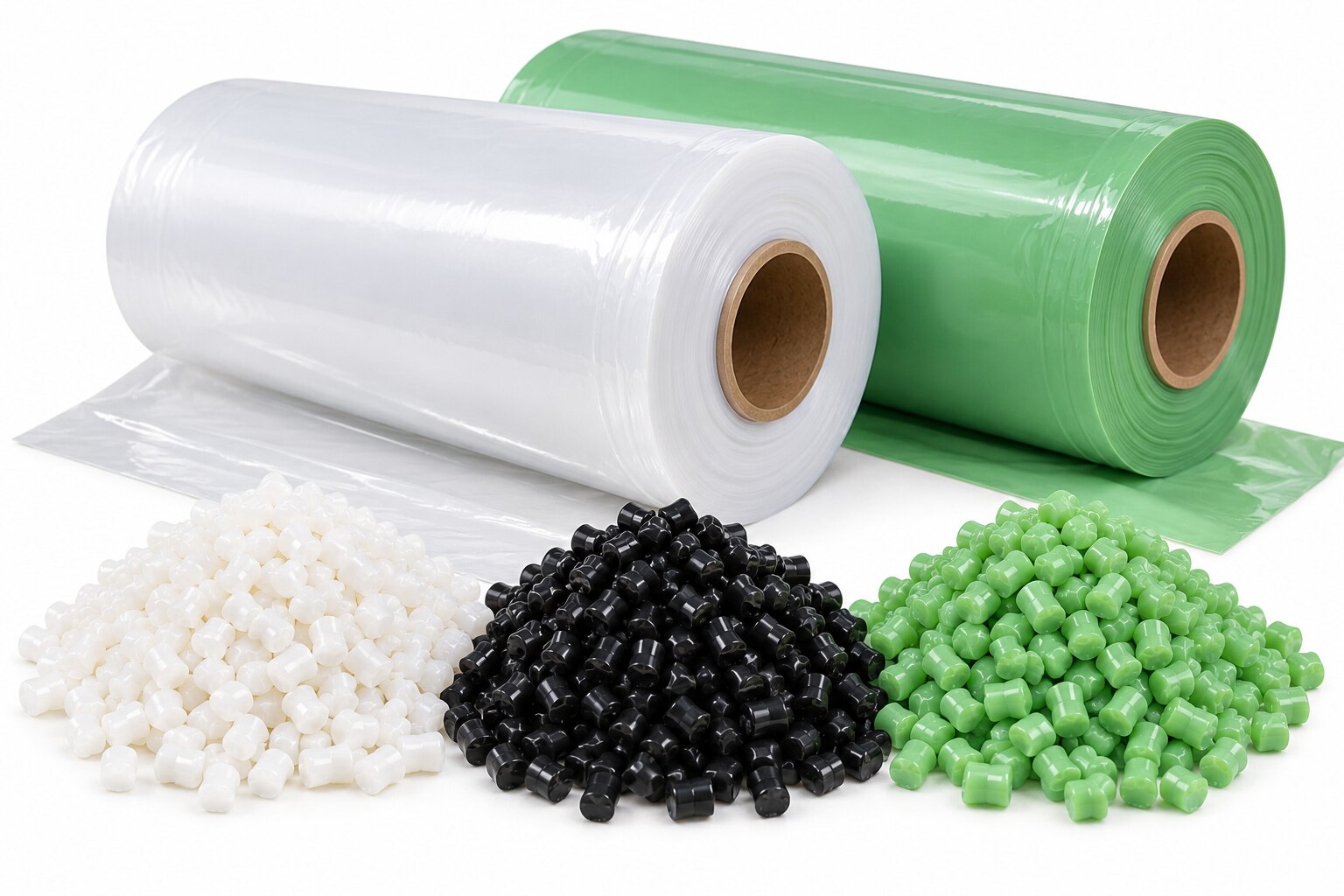
A silage-film masterbatch must match the film structure, resin blend, stretching conditions, colour objective and outdoor exposure—not just the shade shown on a sample card. By the end, you can define the formulation job, calculate a defensible let-down ratio and build a test plan that exposes failures before production.
Key takeaways
- Define film layers, resin grades and processing conditions before selecting concentrate.
- Match each masterbatch carrier to the polyethylene layer receiving it.
- Balance colour, opacity and UV protection instead of choosing them separately.
- Test dispersion, stretch, cling and weathering at production let-down rates.
Define the film structure before choosing a concentrate
Specify the finished film and its process before you compare a silage-film masterbatch. The silage film construction determines whether dispersion, melt strength, cling and stretch survive production: a concentrate suitable for ordinary polyethylene can cause pressure rise, gels or weak spots in a highly stretched metallocene layer.
Record whether extrusion is blown film or cast film, and identify the exact LLDPE and mLLDPE film resin blend, not just “polyethylene.”
- State whether the product is stretch film for bale wrapping or a non-stretch sheet, and give the target film thickness in micrometres.
- List every layer in a three- or five-layer structure, including the resin and intended position of the concentrate.
- Give the bale diameter, number of wraps, stretch percentage and required cling between overlapping layers.
- Identify recycled content, tie-layer or seal-layer materials, and any slip, antiblock, filler or processing-aid concentrates already present.
- Specify the required colour, opacity, storage exposure and expected outdoor service period.
| Construction choice | What to specify | Why it changes selection |
|---|---|---|
| Monolayer blown film | One resin blend and one surface | The concentrate must disperse throughout the full film thickness. |
| Coextruded blown film | Layer count, resin and additive location | A carrier or additive can damage interfaces, cling or seal performance. |
| Cast stretch film | Chill-roll process, layer structure and stretch target | Fast cooling and high draw expose differences in dispersion and melt strength. |
Do not compare concentrates until suppliers confirm compatibility at your actual let-down ratio and in the stated resin blend. Testing a sample in a different layer or process can hide production defects.
Match the carrier and additive package to every film layer
A polyethylene carrier is not automatically compatible with every silage formulation. Check its melt flow, polarity, additive content and processing temperature against the dominant LLDPE, mLLDPE or LDPE resin; a mismatch can create pressure rise, gels, layer-interface defects or weak spots during stretching.
Verify the concentrate against the complete film design:
- Run it at the intended let-down ratio in the actual resin blend, including recycled content.
- Confirm masterbatch carrier resin compatibility with each coextruded layer, tie layer and seal layer, not only the main resin.
- Check dispersion and melt strength in the intended blown or cast process.
- Record which layer receives the concentrate and whether the film is monolayer and multilayer film construction.
Treat cling, antiblock and slip additives as a package. Excessive slip or antiblock on the contact surface can reduce adhesion between overlapping wraps, while too much migratory cling additive can cause roll blocking, dust pickup and unstable unwind. Specify the additive location—inside, outside or both surfaces—and test cling after the film has been stretched.
Request extrusion samples made with the production resin blend, then inspect the film for streaks, fisheyes, gels, thickness variation and delamination.
Measure cling, coefficient of friction, tensile retention and stretch at the target temperature; a concentrate that looks uniform in a monolayer sample can fail when concentrated in one layer of a three- or five-layer structure. Reject it if performance changes after the film is stored, aged or exposed to the intended UV package.
Select colour, opacity and UV protection as one system
Choose pigment and stabiliser loading together: set the required opacity and light transmission, then select the lowest pigment level that meets those targets after stretching. Excess pigment reduces the polymer available for deformation, increasing brittleness, gels, streaks and weak spots. Black versus white silage film also changes bale heating, not just appearance.
| Film design | Pigment choice | Thermal and light effect | Selection check |
|---|---|---|---|
| White outer layer | Surface-treated rutile titanium dioxide | Reflects more solar radiation, heats less and limits light entry | Confirm opacity after stretch; reject untreated or poorly treated TiO2 if it increases photocatalytic degradation or melt-filter loading |
| Black inner layer | Carbon black | Blocks transmitted light but absorbs solar energy, which can raise bale temperature | Balance hiding power against thermal loading and ageing temperature |
| Coloured film | Organic or inorganic pigment selected for the target shade | Light transmission and heating depend on pigment chemistry and loading | Measure colour, opacity and temperature rather than choosing by shade alone |
Treat UV protection as a separate package that works with the pigment. Use HALS with UV absorbers when the expected latitude, storage period, film thickness and stretching history demand it; include thermal antioxidants where processing or exposure requires them. Screen the complete formulation against agrochemical contact.
Compare retained tensile strength, elongation, colour change, puncture impact, cling and blocking after xenon-arc or fluorescent-UV exposure. Those tests rank formulations; they do not convert directly into a fixed number of field months.
Set the let-down and processing window without creating defects
Calculate the addition from the required final pigment concentration, not from colour strength alone. Use: masterbatch dosage (%) = target final pigment concentration (%) ÷ pigment concentration in the masterbatch (%) × 100. A masterbatch containing 25% pigment used at 4% gives a 1% final pigment concentration and a 24:1 resin-to-masterbatch let-down ratio.
Recalculate for each layer and resin blend.
- Confirm the feeder delivers that let-down ratio by weighing output over a timed run; a drifting feeder creates stripes and local weak spots.
- Use the actual LLDPE or mLLDPE blend, including recycled content, during the trial; a carrier that disperses in one resin can form gels or fisheyes in another.
- Set the melt temperature from measured polymer temperature, not only barrel settings; excessive heat accelerates degradation, while an under-melted concentrate leaves agglomerates.
- Set residence time by checking screw speed, output rate and hold-up; long residence time can yellow or degrade the polymer, especially during stops.
- Provide enough screw mixing to disperse pigment, but avoid excessive shear that raises melt temperature and damages melt strength.
Inspect pressure, filter loading and film appearance during a steady run. Rising pressure points to agglomerates or degradation; recurring streaks require checking feed uniformity, screen condition and mixing rather than simply increasing dosage. Keep the lowest loading that meets opacity and colour uniformity, because excess pigment reduces polymer available for stretching and increases defect risk.
Qualify the masterbatch at the film’s real stretch and exposure conditions
Approve a concentrate only after testing film made at the actual let-down ratio, resin blend, thickness and wrapping stretch. Measure dart impact and puncture resistance before stretching and after the intended stretch; excessive orientation can raise tensile strength in one direction while leaving the bale wrap vulnerable to puncture.
| Comparison | What to test | Disqualifying result |
|---|---|---|
| Pre-coloured resin versus masterbatch | Same film structure, colour, opacity, stretch and ageing cycle | Lower retained elongation, poor dispersion or altered cling |
| Dry pigment and liquid colour | Same pigment loading, mixing method and film thickness | Streaks, gels, unstable shade or weaker impact |
| Unfilled resin versus filler masterbatch | Dart impact, puncture resistance, elongation, haze and die stability after stretching | Large loss of elongation, impact strength or a die-break tendency |
| UV package alternatives | Colour change, retained tensile and retained elongation after xenon-arc or fluorescent-UV exposure | Cracking, rapid fading or brittle film |
Run blown or cast production trials, then test aged samples for cling, blocking and unwind behaviour. Inspect the stretched film for gels, fisheyes, streaks and weak spots. Treat accelerated weathering as comparative screening, not a conversion to guaranteed field months; expose samples using the expected film thickness, latitude, storage period and agrochemical contact.
Khetan Polytex Private Limited can support a useful comparison by supplying trial concentrates, but request batch traceability and test the material in your own resin and coextruded layer rather than approving pellets alone.
Related products
 | SILVER MASTERBATCH ₹125 silver masterbatches that have uniform pellet size for better mixing. View product → |
 | masterbatches High-Quality Black Masterbatch Manufacturers and Supplies in India. Khetan Polytex is one of the leading black masterbatch manufacturers in India. View product → |
Frequently asked questions
What film information should you define before choosing a silage-film masterbatch?
Specify the layer structure, polyethylene and metallocene grades, film thickness, stretch ratio, extrusion process and target properties before comparing concentrates.
Why must the masterbatch carrier match the film layer?
A compatible carrier supports dispersion and melt flow, while a poor match can increase pressure, create gels or weaken highly stretched layers.
How should colour, opacity and UV protection be selected?
Treat them as one system because pigment loading, light blocking and stabiliser levels together affect heating, weathering and film performance.
How do you set the masterbatch let-down rate without defects?
Calculate the required pigment or additive dosage, then confirm pressure, dispersion, melt strength and film appearance across the actual processing window.
How should silage-film masterbatch performance be qualified?
Test the finished film at its real stretch, cling, storage and outdoor-exposure conditions, checking weak spots, colour stability, opacity and UV performance.
Related products
 | Desiccant Masterbatch ₹55 Desiccant Masterbatches can counter problems that develop during the processing of plastics due to the presence of moisture and prevents the... View product → |
 | masterbatches ₹200 Khetan Polytex is a leading white masterbatch manufacturers that offer products with wide applications in the plastic industry. View product → |