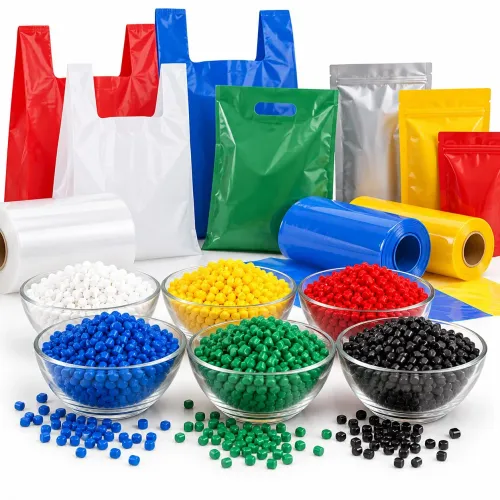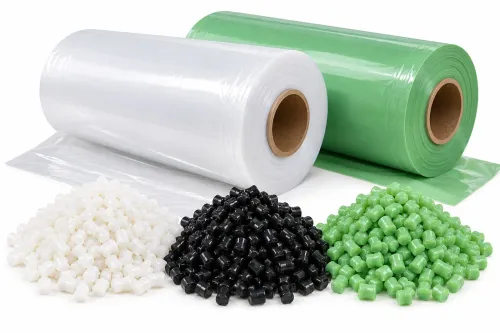
Grow-bag colour affects more than shelf appeal: it influences light transmission, solar heat gain, crop identification and outdoor durability. By the end, you will be able to specify the film structure, calculate masterbatch addition, set up extrusion checks and compare colour and performance evidence before approving a formulation.
Key takeaways
- Choose colour for root-zone light control, heat gain and crop requirements.
- Match masterbatch chemistry and loading to the film resin and structure.
- Calculate addition rates and verify dispersion during film extrusion.
- Approve suppliers using colour data, UV testing and batch documentation.
Choose grow-bag colour for the crop environment, not appearance alone
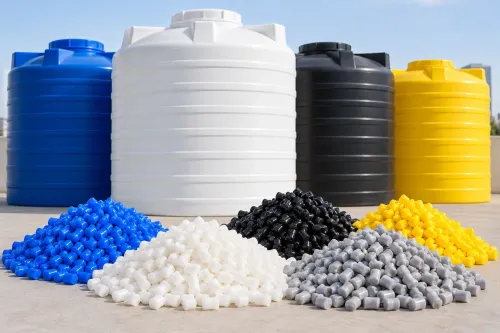
Choose grow bag colour by balancing root-zone light control, heat gain, identification and buyer specifications—not by appearance alone. A light blocking film helps prevent light reaching roots and reduces algae growth, but the chosen pigment also changes solar absorption.
| Grow bag colour | Root-zone implication | Identification and market use |
|---|---|---|
| Black grow bags | Block light effectively, but absorb more solar radiation and can heat the substrate | Common visual standard; useful when dark, uniform packaging is expected |
| White or reflective | Reduce solar heat gain and help moderate root-zone temperature | Suitable where cooler bags, visible cleanliness or reflective surfaces support the market position |
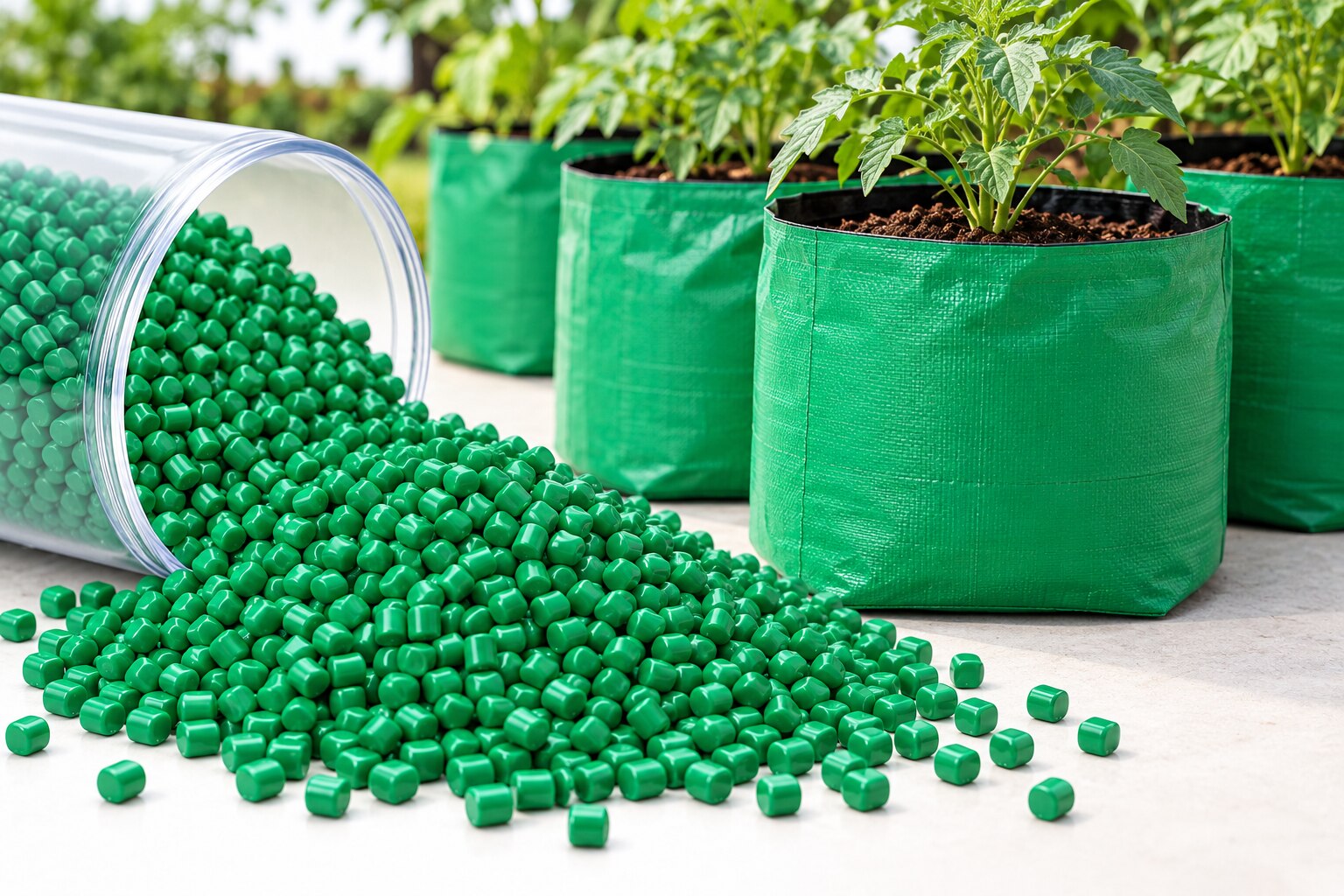
| Green grow bags | Provide a distinct colour identity, but do not guarantee a particular root-zone temperature | Useful for crop, nursery or customer coding when the shade is specified and repeatable |
Colour alone cannot predict temperature. Film thickness, bag orientation, pigment reflectance and multilayer structure also control heat gain, so confirm substrate temperature in the actual growing position.
For a multilayer bag, use a reflective outer skin with a black core when you need both lower heat absorption and strong light blocking. Put UV stabilisers in the exposed polymer layer; black masterbatch is not automatically a complete UV package.
Confirm the selected shade against buyer artwork, crop-segregation rules, nursery handling systems and retail requirements, then approve a physical colour standard for production.
Match the masterbatch to the film resin, structure and loading demands
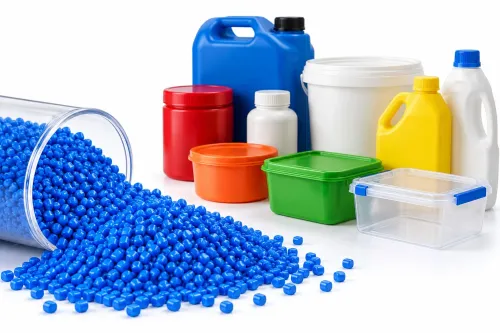
A masterbatch that works in a thin LDPE grow bag film can fail in a thicker, tougher structure. Match the carrier resin, pigment or filler package, and dispersion quality to the actual resin blend, film gauge, construction and stresses.
| Option | Construction or formulation detail | Reliability risk |
|---|---|---|
| LDPE grow bag film | Softer polyethylene, often processed by blown film | An incompatible carrier can cause gels, fisheyes, unstable melt flow or weak seals |
| LLDPE film | Higher toughness and puncture resistance; different melt behaviour | A grade validated only in LDPE may disperse poorly or alter film strength |
| Woven grow bags | Pigment is compounded into tapes, then exposed through weaving, seams and handling | Film-based data does not predict tape strength, colour uniformity or seam durability |
Check the full structure, not only the base resin. Film thickness, gussets, perforations, handles and heat-sealed areas create local stresses during filling, lifting and contact with benches. Calcium-carbonate filler can improve stiffness and reduce resin use, but excessive loading reduces elongation, dart impact, tear resistance and puncture tolerance.
Recycled polyethylene changes melt flow, contamination, colour and weathering response. Test the intended virgin-to-regrind blend, because a plaque made from virgin resin cannot reveal filter pressure, odour, gels or colour drift.
- Confirm the carrier matches every polyethylene layer in a multilayer bag.
- Compare carbon-black dispersion, not just blackness; agglomerates become tear-starting stress points.
- Verify the formulation at the actual film gauge and production temperature.
Calculate addition and control dispersion during film extrusion
A 4% masterbatch let-down ratio means 4 kg of masterbatch in 100 kg of finished compound, not automatically 4 kg added to 100 kg of resin. Calculate the addition from the required active loading:
Masterbatch addition (%) = target active concentration ÷ active concentration in the masterbatch × 100.
A masterbatch with 50% pigment concentration used at 4% addition delivers about 2% pigment in the finished film. Recalculate whenever you change the concentrate, colour strength or UV-additive level.
1. Weigh the full batch, including natural resin and regrind, before setting the feeder. For 1,000 kg of finished compound at 4% addition, use 40 kg masterbatch and 960 kg base material.
2. Use a gravimetric feeder where possible, and calibrate it against actual output. A volumetric feeder can drift when pellets vary in bulk density, producing colour bands and inconsistent additive protection.
3. Check the intended resin blend during film extrusion. Regrind can alter melt flow, contamination, gels, odour and background colour, so a rate proven in virgin polyethylene may not suit the production blend.
Keep the masterbatch carrier compatible with the LDPE or LLDPE. Poor compatibility, inadequate mixing or excessive dosing creates agglomerates, specks, gels and weak tear points. Carbon black agglomerates act as stress concentrators; equal let-down ratios do not guarantee equal UV performance. Treat black colour concentrate as UV screening, not automatically as a complete stabiliser package.
Qualify UV life, mechanical strength and outdoor performance together
A grow bag earns approval only when it retains strength after UV exposure and survives puncture, tearing and handling. Test the finished film, not just the resin or masterbatch: ASTM D882 measures tensile strength and elongation, but tensile results alone can miss damage from sharp substrate particles.
- Run ASTM D1709 falling-dart impact and ASTM D1004 tear resistance on production film, including gusset, seam and perforated areas.
- Compare unexposed samples with samples after an agreed accelerated weathering programme, such as ASTM G154, and with bags held outdoors through the intended growing season.
- Record retained tensile, impact and tear performance, visible cracking, chalking, colour change and seal failure. A bag that looks stable but splits during filling has failed.
| Stabilisation choice | What it contributes | What to verify |
|---|---|---|
| Carbon black | Strong ultraviolet screening in polyethylene | Particle size, structure, loading and dispersion; agglomerates can reduce impact and tear strength |
| UV stabilisation with hindered amine light stabilisers or UV absorbers | Protection through mechanisms different from pigment screening | Polymer type, film thickness, exposed area, climate and pesticide exposure |
| Rutile titanium dioxide | Weatherable opacity for white film | Use a suitable surface-treated grade; untreated anatase can accelerate polymer oxidation |
| Black colour alone | Light blocking and some UV protection | Do not treat it as a complete stabiliser package without weathering and retained-property data |
Control pigment dispersion by checking film sections for specks and agglomerates. Approve the formulation only when colour, outdoor appearance and mechanical retention meet the same specification.
Use measurable colour control and supplier documentation before approval
Do not release a grow-bag masterbatch from a visual shade sample alone. Approve it against film made with the intended resin blend, layer position and extrusion process.
Require this evidence before sign-off:
1. Production traceability: record masterbatch lot, resin grade, recycled-content percentage, let-down rate, film thickness, line temperature, screw speed and layer allocation. Record filter pressure, gels, fisheyes, odour and visible colour drift during the run.
2. Colour measurement: measure the diluted film with a calibrated spectrophotometer, using the same illuminant, observer and measurement geometry each time. Record CIELAB values and the agreed Delta E tolerance against the approved standard; test more than one point across the film width.
3. Resin-blend validation: compare virgin and intended recycled polyethylene blends. Recycled feedstock can change melt flow, contamination, apparent shade and weathering response, so a matching laboratory plaque is not enough.
4. Supplier data: request the masterbatch technical data sheet, certificate of analysis, carrier-resin identity, pigment or additive details, recommended let-down range, heat-stability limit and storage conditions. For multilayer film, confirm compatibility with tie layers, sealing conditions, slip and antiblock levels.
5. Release criteria: reject a lot that exceeds the Delta E limit, causes unstable filter pressure, weak seals, poor interlayer bonding or unacceptable coefficient of friction.
Ask Khetan Polytex Private Limited to supply these records for each proposed lot, not only a catalogue shade, so colour matching remains traceable after dilution in production.
Frequently asked questions
How should you choose a grow-bag colour?
Balance root-zone light control, algae prevention, solar heat gain, crop environment, identification and buyer specifications.
How do you match masterbatch to a grow-bag film?
Check compatibility with the film resin, multilayer structure, processing conditions, required loading and mechanical demands.
How do you control masterbatch addition and dispersion?
Calculate addition from the concentrate strength and target pigment level, then inspect film uniformity during extrusion.
What tests should qualify grow-bag performance?
Evaluate colour, UV exposure life, tensile strength, elongation, tear resistance and outdoor performance together.
What supplier documents should you request before approval?
Request the technical data sheet, safety data sheet, recommended dosage, processing guidance, batch information and colour-control records.