A multilayer gas-cylinder tank can show different shades even when every extruder receives the same colour dosage. To control the result, you need to assign colour to the correct layer, match each masterbatch to its resin and process window, then approve the formed tank with measurements that account for thickness, curvature and service exposure.
Key takeaways
- Colour the layer that defines the tank’s visible surface.
- Match masterbatch chemistry and dosage to each resin layer.
- Control feeder calibration, melt temperature and residence time during coextrusion.
- Approve colour using defined sampling, measurement and production checks.
Which tank layer should receive the colour, and why?
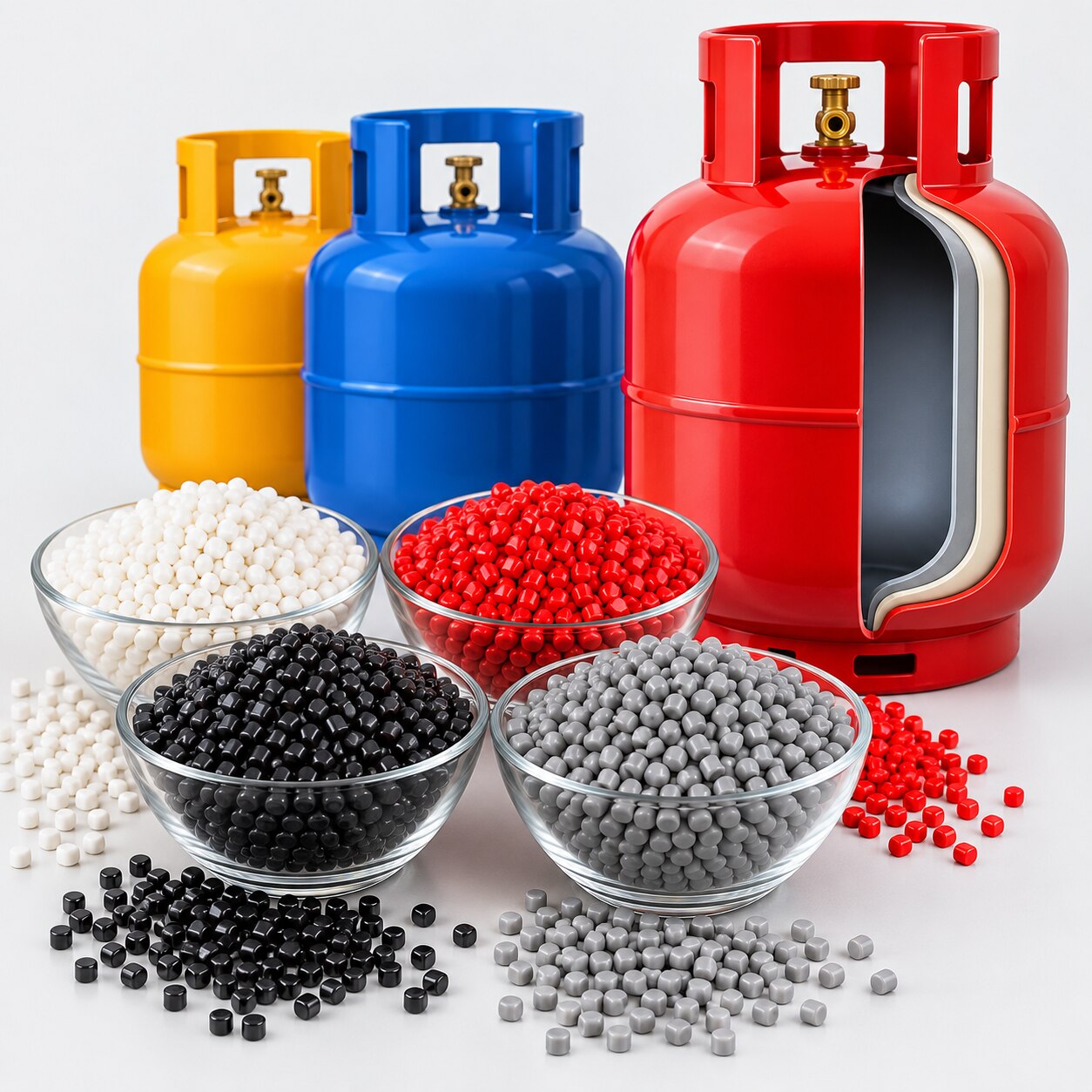
A multilayer gas cylinder tank should be coloured according to the surface being judged, not by copying one shade into every melt. A wall may contain a PA liner or HDPE inner liner, EVOH barrier layer, adhesive tie layers, PP or HDPE outer layer, fibre reinforcement and an external overwrap.
Each layer has a separate purpose, thickness and optical contribution.
| Layer | Colour decision | Why |
|---|---|---|
| PA or HDPE liner | Colour it only if the inside, translucent wall or exposed liner is judged | The liner contacts gas or fuel, so migration, bleeding and permeation checks accompany colour approval |
| EVOH barrier layer and tie layers | Usually leave uncoloured unless they affect visible transmission or interface staining | Their thin mass makes colour contribution small, but incompatibility can create streaks or shade shifts |
| HDPE outer layer or PP skin | Usually place the principal colour here | A thin, opaque outer skin can dominate the observed appearance |
| Fibre overwrap, coating or label | Include it in the external colour specification | A cured overwrap or label can hide the liner and control the visible surface |
A masterbatch colours only the polymer melt in the extruder where you dose it. A buried layer changes the shade only where the outer skin is translucent or locally thin; the same percentage in every extruder does not create uniform colour through the wall or uniform colour outside.
Crystallinity, refractive index, gloss, orientation, weld lines, knit lines and curved viewing geometry alter reflected light.
Approve a representative cylindrical, blow-moulded or overwrapped tank section, not just a flat plaque. A plaque can match while curvature, layer distribution and moulded surface finish produce a visible tank mismatch.
How do you formulate and dose colour for different resin layers?
Calculate each layer’s let-down ratio from its own mass and target pigment loading. For a 500 kg layer at a 3% let-down ratio, set the feeder to deliver 15 kg of masterbatch and 485 kg of host resin.
A 0.45% target pigment loading with a masterbatch containing 15% pigment gives the same starting masterbatch dosage: 0.45 ÷ 15 × 100 = 3%, subject to trials.
Do not copy that percentage into every extruder. The same masterbatch dosage can produce different shades because layer mass, thickness, opacity, pigment strength, fillers and optical backing change the result.
| Resin layer | Why the same dosage looks different | Required check |
|---|---|---|
| HDPE | Crystallinity, gloss and hiding power alter lightness | HDPE compatibility, carrier chemistry and melt flow |
| PA | Refractive index and melt conditions shift shade and dispersion | PA carrier compatibility and interface behaviour |
| PP | Different flow and shrinkage affect thickness and appearance | PP compatibility and weld performance |
| EVOH | Thin barrier layers contribute differently to visible colour | Barrier, migration and permeation testing |
| Tie-layer compound | Adhesive chemistry can change rheology and interface colour | Bonding, bleeding and welding checks |
Carbon black darkens and raises opacity; titanium dioxide controls whiteness and scattering. Calcium carbonate, talc and glass fibre alter undertone, gloss, rheology and dispersion. UV stabilisers, flame retardants, antioxidants and recycled content can shift shade or processing behaviour, so approve the complete formulation.
For a coloured liner or tie layer, test gas contact, migration, bleeding, permeation and welding before release. A general PE or PP claim is not a resin-by-resin compatibility check.
How does coextrusion processing preserve colour from feeder to formed tank?
Separate dosing for each extruder prevents one feeder error from changing several tank layers at once. A gravimetric feeder is preferred for tight colour control because it corrects for changing pellet bulk density and flowability; a volumetric feeder needs more frequent verification.
Feeder and melt-control checks should include:
- Calibrate at the actual low feed rate, not only at the machine’s normal output.
- Check pellet size distribution, bridging, rat-holing and pulsation.
- Record screen-pack pressure before and after adding concentrated additives.
- Confirm that melt filtration does not create excessive pressure drop or unstable layer flow.
- Verify dispersion before forming; poor dispersion creates specks, local opacity, layer-thickness disturbance and visible shade variation after blow moulding.
| Control | Main risk | Required check |
|---|---|---|
| Gravimetric feeder | Drift from poor calibration or pulsation | Recheck mass output at the target rate |
| Volumetric feeder | Bulk-density and flowability changes | Increase verification frequency |
| Melt filtration | Pressure rise and layer instability | Track screen-pack pressure and change limits |
Different screws can give each layer a different shear history, residence time and melt temperature. Pigment or carrier degradation in one extruder can cause yellowing, dullness or black specks while another layer remains unchanged.
A claimed 260°C heat-stability figure proves little without its test method and overlap with every resin’s melt-temperature window, residence time and start-up exposure.
Use a controlled purge sequence, wait for thermal equilibrium, change screen packs under a defined procedure, and discard transient start-up material until colour and layer distribution stabilise. Otherwise purge residue or previous-colour contamination can appear as a faulty formulation.
How should a multilayer tank colour be measured, sampled and qualified?
Approve colour against two physical references: a flat plaque made from the specified formulation and a representative formed tank section containing the controlled layer structure. Measure both with a calibrated spectrophotometer in CIELAB, recording the agreed illuminant, observer angle, aperture, backing and gloss condition.
Use ASTM D2244 to calculate Delta E, but set separate review limits for ΔL*, Δa* and Δb*; one overall value can hide an obvious hue or lightness error.
| Reference | What it controls | Limitation |
|---|---|---|
| Plaque | Resin, pigment loading and repeatability | Does not reproduce curvature, orientation or layer interfaces |
| Formed section | Final optical stack and process appearance | Must represent production layer thickness and forming history |
| Finished tank | External appearance under defined lighting | Overwrap, coating or label can mask liner colour |
Sample the shoulder, cylindrical body, base, weld or knit lines, and start-stop regions. These locations experience different flow histories and layer distributions. Inspect under a defined light source, comparing the actual external optical stack, including any translucent overwrap, coating or label.
Colour approval sits beside cylinder qualification, not above it. Confirm the design and transport standard for the intended gas and country, such as ISO 11439 for certain CNG vehicle cylinders or the relevant ISO 11119 series, then complete:
- Burst pressure testing and cyclic pressure testing
- Leakage and permeation testing
- Impact and temperature-cycling tests
- Chemical-exposure and weathering tests
A matching shade proves none of these pressure, barrier or durability functions.
How do you compare colour supply options and approve a production partner?
Approve a masterbatch only when it controls colour without increasing the risk of a rejected pressure vessel. Compare each option against the actual HDPE, PA, PP, EVOH or tie-layer formulation, not a generic resin claim.
| Option | Dosing and process effects | Main exposure |
|---|---|---|
| Pelletised masterbatch | Accurate gravimetric feeding, low dust, normal feeder cleaning and repeatable batches; verify carrier compatibility and dispersion. | Purge waste, calibration time and filter pressure during colour changes. |
| Pre-coloured resin | Consistent dosing with no colour feeder, but requires separate resin inventory and longer material changeovers. | Higher stock cost and greater rejected-tank exposure if the shade is wrong. |
| Liquid colourant | Requires pumps, mixing and spill control; dosing drift, migration and cleaning can undermine repeatability. | Residual liquid, interface staining and lengthy cleanup. |
| Pigment powder | Lowest formulation convenience; dust control, specialist feeding and dispersion are critical. | Specks, streaks, exposure risk and high start-up scrap. |
Cost a colour change by adding purge material, downtime, feeder calibration, screen-pack or filter changes, start-up scrap and shade reapproval. A cheaper colourant loses its advantage if one failed tank batch consumes the saving.
Request this evidence before approval:
- Carrier resin, pigment or dye identity, recommended dosage range, melt-flow data, heat-stability method, light-fastness method and regulatory declarations.
- A certificate of analysis, lot traceability, change-notification process and layer-specific trials using the complete formulation.
- Results for barrier performance, gas-contact compliance, welding or bonding, filtration pressure, weathering and chemical exposure.
Khetan Polytex Private Limited belongs in the comparison only when it supplies that evidence for the actual layer recipes. Reject any colourant that exceeds the agreed ΔL*, Δa* or Δb* limits; final approval still requires complete cylinder qualification.
Frequently asked questions
Which tank layer should receive the colour?
Colour the layer that determines the judged appearance, usually the external visible layer. Do not add the same pigment to hidden liner, barrier or adhesive layers unless they need colour for identification or process control.
How should colour masterbatch be formulated and dosed for different resin layers?
Match the carrier resin, pigment compatibility, thermal stability and required opacity to each layer. Set dosage through trials using the actual resin, layer thickness and target colour rather than copying one dosage across all melts.
How can coextrusion preserve colour from feeder to formed tank?
Calibrate each gravimetric or volumetric feeder, verify blend uniformity, control melt temperature and residence time, and check die and equipment cleanliness. Confirm colour after forming because stretching and layer thickness changes affect appearance.
How should multilayer tank colour be measured and qualified?
Define the viewing surface, lighting condition, measurement geometry, colour tolerance and sampling locations before production. Measure formed tanks or representative plaques, record instrument data and inspect welds, curvature and thickness transitions.
How should you compare colour supply options and approve a production partner?
Compare colour consistency, resin-specific formulations, technical data, batch traceability, feeder trials, change-control records and support during scale-up. Approve the partner only after repeat production meets the agreed colour and process criteria.