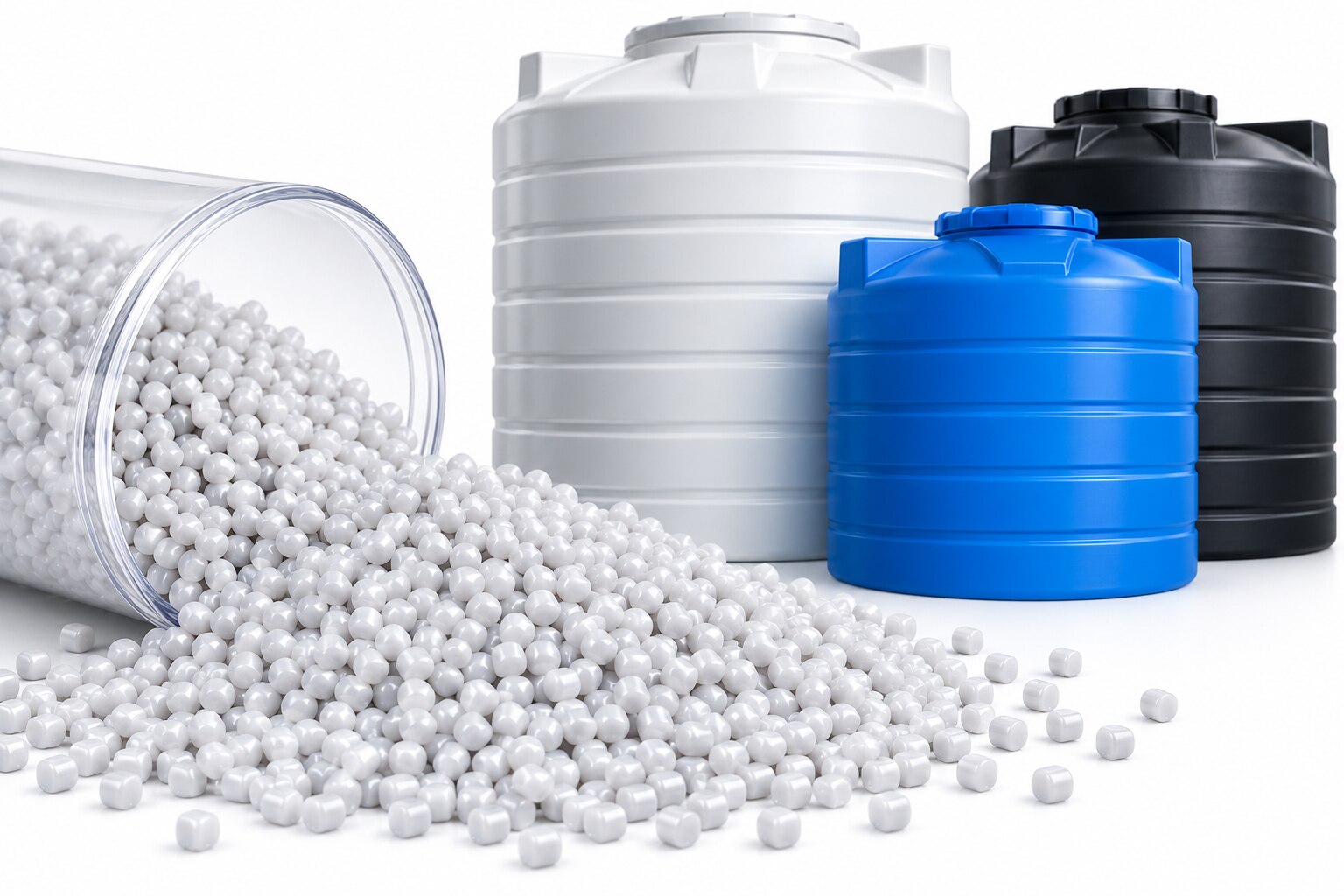
A masterbatch that produces an attractive colour is not automatically suitable for a drinking-water tank. You need to match the concentrate to the tank process and resin, verify the finished formulation for water contact, and test durability at the actual dosage before approving production.
Key takeaways
- Match the masterbatch carrier and form to the tank process and base resin.
- Calculate let-down ratio before setting colour, additive and processing targets.
- Request water-contact evidence for the finished tank formulation, not just the masterbatch.
- Trial the complete formulation to check colour, opacity, UV protection and tank temperature.
Start with the Tank Process and Base Resin
Select the masterbatch form and carrier only after identifying how you make the tank. A powder suited to rotational moulding is not interchangeable with a pellet designed for blow moulding or injection moulding fittings.
| Process | Suitable masterbatch focus | Main risk if mismatched |
|---|---|---|
| Rotational moulding | Powder-process evidence and dry-blend compatibility | Streaks, unmelted particles and local over-concentration |
| Blow moulding | Pellet dispersion, melt flow and parison-process stability | Uneven colour or unstable wall distribution |
| Injection moulding fittings | Pellet feed consistency and short-cycle melt stability | Specks, shade variation or blocked flow paths |
Match the carrier to the tank resin. An HDPE carrier resin for masterbatch is the logical starting point for an HDPE tank, while an LLDPE tank needs a carrier with compatible melt flow, processing temperature and thermal stability. Confirm these values against the exact resin grade, not merely the polymer family.
For a rotational moulding masterbatch, request evidence covering:
- Particle-size distribution
- Bulk density
- Dry-blending uniformity
- Pigment dispersion
- Performance during the complete heat cycle
A pellet masterbatch proven in injection moulding can behave poorly in a rotating mould because it does not distribute or melt like the powder process requires.
Put the resin grade, moulding method, wall thickness and residence time in the purchasing specification. These details define the process window used to approve the concentrate.
Control Let-Down Ratio and Processing Conditions
1. Define masterbatch dosage as a controlled range, with every percentage based on final-compound weight. A let-down ratio calculation of 1:20 means one part masterbatch plus 20 parts natural resin: 1 ÷ 21 = 4.76% of the final blend.
If dosage is stated against resin weight, label it separately; 1 part per 100 parts resin equals 0.99% of the final blend.
2. Set separate trial bands rather than one informal colour recipe. Use these as validation starting points, not universal approvals:
- Black masterbatch dosage: 1–3% of final blend.
- White masterbatch opacity dosage: 2–6%, measured at the thinnest tank wall.
- Colour masterbatch: 1–4%.
- Filler masterbatch: 5–20%.
- Desiccant masterbatch: 0.5–2%.
Under-dosing can leave colour variation, inadequate opacity or weak UV protection. Over-dosing can alter melt rheology, impact strength, environmental stress-crack resistance, oxidation stability and migration.
3. Approve the top of each range under the harshest process condition: maximum concentration, highest melt temperature and longest residence time. Test coloured production plaques or tank sections for melt flow, hydrostatic strength, impact resistance, environmental stress-crack resistance, oxidation-induction behaviour, weathering and migration.
Record the minimum wall thickness, maximum water-contact temperature, largest surface-area-to-volume ratio and intended outdoor exposure; validating only the nominal recipe can conceal failures.
Demand Evidence for the Finished Tank’s Water Contact
A coloured tank is not proven safe by a “food-contact” label on the masterbatch. Request evidence for the finished formulation, including the base resin, masterbatch carrier, dosage and intended water-contact conditions. A potable-water contact masterbatch is only one component of that assessment.
Ask the supplier for:
- The exact carrier-polymer identity, such as HDPE or LLDPE, and a complete declaration listing pigments, antioxidants, UV stabilisers, processing aids, antimicrobial ingredients and every other intentionally added substance.
- Migration testing or extraction results for the actual tank conditions: water temperature, contact time, processing history and surface-area-to-volume ratio. Request taste-and-odour results or finished-product sensory data where the approval scheme requires them.
- For North American projects, evidence that the finished tank formulation and use category were assessed under NSF/ANSI/CAN 61. A certificate covering the masterbatch alone does not establish compliance for the tank.
- For EU-market products, an EU Regulation 10/2011 declaration, supported by overall-migration and specific-migration results. Treat this as supporting evidence, not automatic potable-water approval, because EU food-contact compliance is not identical to drinking-water approval.
Check that every result matches the actual carrier, base resin, let-down ratio, moulding temperature, residence time and wall thickness. A test on a different formulation does not close the evidence gap.
Handle antimicrobial claims as a separate approval question: they can add leachable substances, taste or odour concerns and biocidal obligations. Treat recycled or unknown regrind separately too; its composition and prior-use history can invalidate the declaration.
Balance UV Protection, Opacity and Tank Temperature
Set the outdoor exposure, allowable colour change, and required weathering duration before choosing a concentrate. For outdoor polyethylene tanks, define the site’s sunlight, climate and service life, then set a measurable colour-retention limit such as a ΔE value.
| Package | What to verify | Main risk |
|---|---|---|
| Carbon black | Grade, particle-size distribution, structure, loading and dispersion | Darkness alone does not prove carbon black UV protection; poor dispersion leaves weakly protected regions |
| Coloured concentrate | Pigment durability, UV protection and colour retention after an accelerated weathering test | Colour can remain attractive while the polymer loses strength |
| White concentrate | white masterbatch opacity at the specified plaque thickness or minimum tank-wall section | Visual whiteness does not prove light blocking or low water temperature rise |
Specify UV protection separately from the antioxidant package. Carbon black screens ultraviolet radiation; antioxidants protect polyethylene during processing and service. Ask for results on coloured production plaques or tanks covering weathering, oxidation-induction behaviour, impact strength and environmental stress-crack resistance.
Compare white masterbatch opacity with heat absorption and surface-temperature rise for tanks in direct sun. A white surface can block light yet still perform poorly if opacity is inadequate at the thinnest wall.
Validate the formulation at the worst case: minimum wall thickness, maximum dosage, highest processing temperature, longest residence time, maximum water-contact temperature, largest surface-area-to-volume ratio and intended outdoor exposure. A colour match that passes only the nominal recipe is not approval.
Use a Supplier Trial to Approve the Complete Formulation
Compare suppliers through the same production trial, not colour chips or supplier data alone. Record carrier identity, pigment or additive composition, batch number, recommended let-down range, melt-flow data, processing window and storage conditions. State whether dosage is calculated against resin weight or final-blend weight.
| Criterion | Supplier 1 | Supplier 2 |
|---|---|---|
| Carrier and composition | Identity, pigments, additives | Identity, pigments, additives |
| Dosage and batch | Let-down range and batch number | Let-down range and batch number |
| Process data | Melt flow, temperature window, storage | Melt flow, temperature window, storage |
| Production result | Uniformity, streaks, specks, unmelted particles, surface defects | Uniformity, streaks, specks, unmelted particles, surface defects |
| Validation evidence | Finished-tank test results and specimen records | Finished-tank test results and specimen records |
Run each candidate in the production machine at the proposed dosage and worst-case dosage. Inspect the finished tank or representative production sections, then complete finished tank validation for:
- Hydrostatic strength, impact resistance and environmental stress-crack resistance
- Oxidation-induction behaviour and accelerated-weathering performance
- Migration and sensory performance under the intended water-contact conditions
Maintain batch traceability from resin and masterbatch batch numbers to moulding records and test specimens. Repeat approval after any change to pigment, carrier, additive package or dosage.
Khetan Polytex Private Limited is useful at this decision point when it supplies application-specific data and supports a controlled trial; treat that support as evidence to assess, not a substitute for independent validation.
Related products
 | masterbatches High-Quality Black Masterbatch Manufacturers and Supplies in India. Khetan Polytex is one of the leading black masterbatch manufacturers in India. View product → |
 | masterbatches ₹200 Khetan Polytex is a leading white masterbatch manufacturers that offer products with wide applications in the plastic industry. View product → |
Frequently asked questions
How does the tank process affect masterbatch selection?
Match the masterbatch form and carrier to the process and base resin. Powder suited to rotational moulding is not interchangeable with pellets for blow moulding or injection moulding.
Why does let-down ratio matter for drinking water tanks?
The let-down ratio determines the concentration of colour and additives in the resin. Confirm it alongside melt temperature, mixing and residence-time conditions.
What water-contact evidence should tank manufacturers request?
Request evidence covering the finished tank formulation, including the base resin, masterbatch, additive package and intended drinking-water contact.
How should manufacturers balance UV protection and opacity?
Compare UV protection, pigment loading, opacity and heat absorption together. A darker or more opaque tank can change solar heating and tank temperature.
Related products
 | Desiccant Masterbatch ₹55 Desiccant Masterbatches can counter problems that develop during the processing of plastics due to the presence of moisture and prevents the... View product → |
 | FILLER MASTERBATCH Most Reliable Filler Masterbatch Manufacturers in Jaipur, India We have been continuously innovating their product lines to keep up with the demands... View product → |
 | Khetan Polytex are leading colour master batches manufacturers in India, Jaipur. Colour Masterbatches are used for coloring plastics and their dyes. View product → |